Angle of Right Angled Triangular Prism Total Internal Reflection
A parallel light beam is incident from air at an angle onto the side of a right-angled triangular prism having refractive index . Light undergoes total internal reflection inside the prism at face when takes a minimum value of . Determine the prism angle .
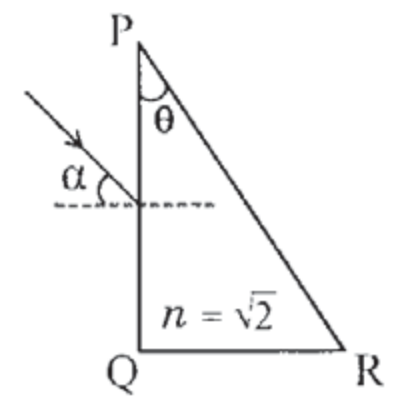
Options
Topics & Concepts
Step-by-Step Solution
To determine the prism angle , we analyze the path of the light beam step-by-step using Snell's Law and the geometry of the prism.
Step 1: Refraction at Face
Applying Snell's Law at the air-prism interface on side :
Given that the refractive index of the prism is :
Step 2: Relation Between Angle of Incidence at and Geometry
Consider the triangle formed by the apex , the point of incidence on side , and the point of incidence on side .
- The angle at vertex is .
- The normal to face is perpendicular to , so the angle between the refracted ray and side inside the triangle is .
- Thus, the angle of incidence at face is related to the prism angle and the angle of refraction by:
Step 3: Critical Angle for Total Internal Reflection (TIR)
For total internal reflection to occur at the prism-air interface , the angle of incidence must be greater than or equal to the critical angle :
Thus, the condition for TIR is:
Step 4: Minimum Incident Angle
Since increases monotonically as increases, also increases with . Therefore, total internal reflection occurs for all .
At the threshold value , the angle of incidence at equals the critical angle ().
First, find when :
Now, substitute and into :
Thus, the prism angle is .
Correct Option: (A)