Variation of Current Density in Conducting Material Inside Cylindrical Shell
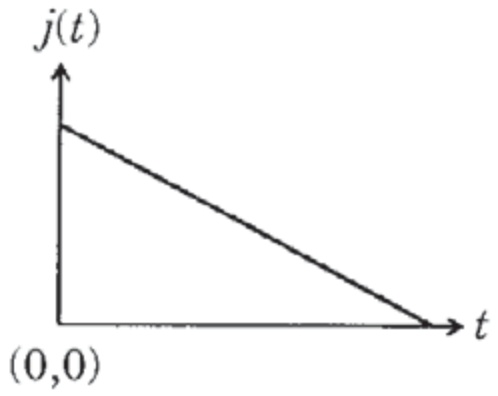
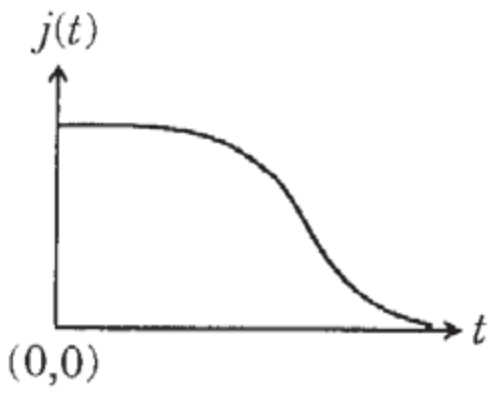
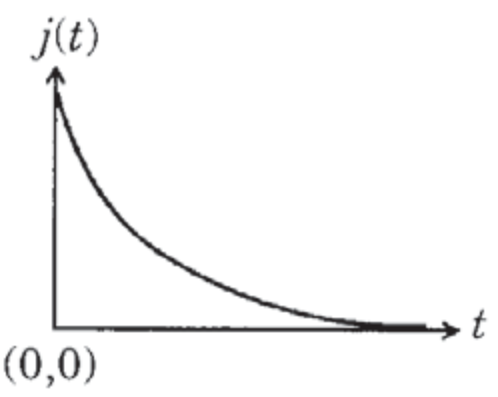
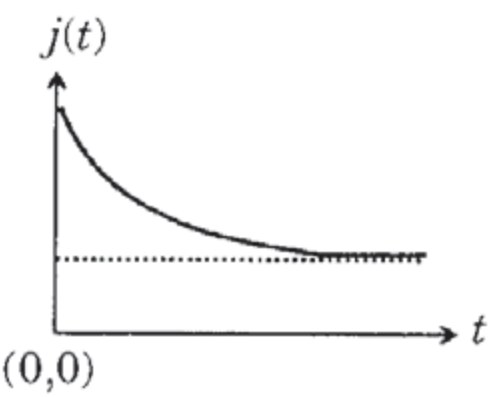
Consider an infinite line charge having uniform electric charge density lying along the central axis of an electrically conducting infinite cylindrical shell of radius . At , the interior volume of the cylinder is filled with a medium characterized by permittivity and electrical conductivity . Conduction in this material obeys Ohm's law. Select the graph that correctly represents the variation over time of the magnitude of current density at a point within the material.
Options
Topics & Concepts
Step-by-Step Solution
To determine the time-variation of the current density within the conducting material, we analyze the system using Maxwell's equations and the equation of charge continuity.
1. Continuity Equation and Volume Charge Density
The electrical current density in a medium with conductivity obeys Ohm's law:
By Gauss's law in a medium with permittivity , the volume charge density is related to the electric field by:
The continuity equation representing charge conservation is given by:
Substituting into the continuity equation:
Rearranging gives the differential equation for the volume charge density inside the bulk of the medium:
Solving this differential equation yields:
Since no initial volume charge density exists inside the bulk medium () at , we have . Consequently, for all at any time . Thus, charge flows radially outwards without accumulating inside the volume of the conductor.
2. Decay of Line Charge Density
Since the charge density inside the volume remains zero, the electric field at a distance () from the central axis depends entirely on the remaining line charge density at the central axis:
The total outward current per unit length flowing through a coaxial cylindrical surface of radius is:
By charge conservation on the line charge at , the rate of decrease of the line charge density equals the outward current per unit length:
Substituting into the expression for :
Equating the two expressions for :
Integrating with the initial condition :
3. Time Variation of Current Density
The current density at any point at a distance from the central axis inside the material is given by Ohm's law:
Substituting :
Letting and defining the relaxation time :
Conclusion
The magnitude of the current density decreases exponentially over time, starting from a maximum initial value at and asymptotically approaching zero as . This exponential decay curve is accurately depicted in Graph (C).
Correct Answer: C