JEE Challenger
More from Thermal Properties of Matter

Minimum Power of Water Cooler for Thermal Load Device

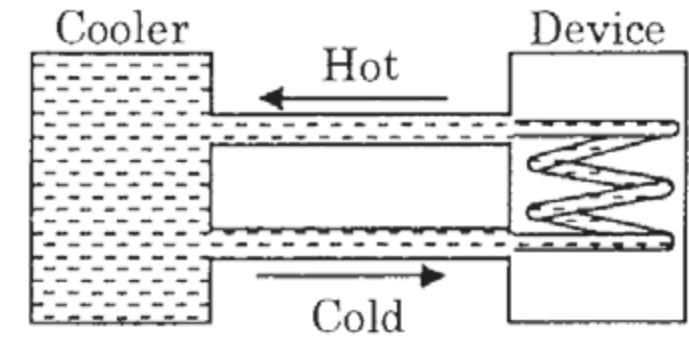
A water cooling unit with a storage volume of 120 litres120\text{ litres} cools water at a constant rate of P wattsP\text{ watts}. In a closed circulation setup (as depicted in the figure), water from this cooler cools an external device that generates a constant thermal load of 3 kW3\text{ kW}. The temperature of the water entering the device must not exceed 30∘C30^\circ\text{C}, and the initial temperature of all 120 litres120\text{ litres} of stored water is 10∘C10^\circ\text{C}. Assuming the system is thermally insulated, find the minimum cooling power PP (in watts) required to operate the device for 3 hours3\text{ hours}.

(Specific heat capacity of water is 4.2 kJ kg−1 K−14.2\text{ kJ kg}^{-1}\text{ K}^{-1} and density is 1000 kg m−31000\text{ kg m}^{-3})

Question Diagram 1

Options

A

1600

B

2067

Correct
C

2533

D

3933

Step-by-Step Solution

To find the minimum cooling power PP required to operate the external device for 3 hours3\text{ hours}, we perform a total thermal energy balance on the closed system.

1. Identify Given Parameters

  • Storage volume of water, V=120 litresV = 120\text{ litres}
  • Density of water, ρ=1000 kg m−3  ⟹  Mass of water m=120 kg\rho = 1000\text{ kg m}^{-3} \implies \text{Mass of water } m = 120\text{ kg}
  • Specific heat capacity of water, s=4.2 kJ kg−1 K−1=4200 J kg−1 K−1s = 4.2\text{ kJ kg}^{-1}\text{ K}^{-1} = 4200\text{ J kg}^{-1}\text{ K}^{-1}
  • Initial temperature of water, Ti=10∘CT_i = 10^\circ\text{C}
  • Maximum allowable temperature of water, Tf=30∘CT_f = 30^\circ\text{C}
  • Thermal load of the device, Pload=3 kW=3000 WP_{\text{load}} = 3\text{ kW} = 3000\text{ W}
  • Operation time, t=3 hours=3×3600 s=10800 st = 3\text{ hours} = 3 \times 3600\text{ s} = 10800\text{ s}

2. Energy Balance Calculation

The total heat energy added to the water in time tt increases its temperature from Ti=10∘CT_i = 10^\circ\text{C} to the maximum permitted value of Tf=30∘CT_f = 30^\circ\text{C}.

The maximum allowable heat energy accumulated in the water is: ΔQ=m⋅s⋅ΔT\Delta Q = m \cdot s \cdot \Delta T

Substituting the values: ΔT=Tf−Ti=30∘C−10∘C=20 K\Delta T = T_f - T_i = 30^\circ\text{C} - 10^\circ\text{C} = 20\text{ K}

ΔQ=120 kg×4200 J kg−1 K−1×20 K=1.008×10⁷ J\Delta Q = 120\text{ kg} \times 4200\text{ J kg}^{-1}\text{ K}^{-1} \times 20\text{ K} = 1.008 \times 10^7\text{ J}

The net rate of heat input into the water system is the difference between the heat generated by the device and the heat removed by the cooler: Pnet=Pload−P=(3000−P) WP_{\text{net}} = P_{\text{load}} - P = (3000 - P)\text{ W}

The total net heat transferred to the water in time tt is: ΔQ=Pnet×t=(3000−P)×10800\Delta Q = P_{\text{net}} \times t = (3000 - P) \times 10800


3. Solving for Minimum Power PP

Equating the two expressions for ΔQ\Delta Q: (3000−P)×10800=1.008×10⁷(3000 - P) \times 10800 = 1.008 \times 10^7

3000−P=10,080,00010,8003000 - P = \frac{10,080,000}{10,800}

3000−P=28003≈933.33 W3000 - P = \frac{2800}{3} \approx 933.33\text{ W}

P=3000−28003=62003 W≈2066.67 WP = 3000 - \frac{2800}{3} = \frac{6200}{3}\text{ W} \approx 2066.67\text{ W}

Rounding off to the nearest integer gives: P≈2067 WP \approx 2067\text{ W}


Conclusion

The minimum cooling power required is 2067 W2067\text{ W}.

Correct Option: (B)