Soap Bubble Pressure Difference and Air Flow
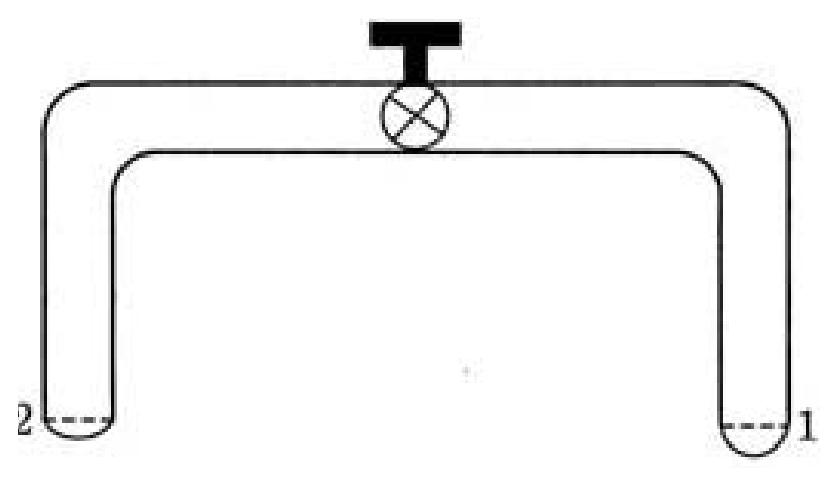
A glass tube of uniform internal radius has a valve separating the two identical ends. Initially, the valve is in a tightly closed position. End 1 has a hemispherical soap bubble of radius . End 2 has sub-hemispherical soap bubble as shown in figure. Just after opening the valve,
Options
air from end 1 flows towards end 2. No change in the volume of the soap bubbles
air from end 1 flows towards end 2. Volume of the soap bubble at end 1 decreases
no change occurs
air from end 2 flows towards end 1. Volume of the soap bubble at end 1 increases
Topics & Concepts
Step-by-Step Solution
To determine the behavior of the system just after opening the valve, we analyze the excess pressure inside the soap bubbles at both ends of the tube.
1. Excess Pressure in a Soap Bubble
The excess pressure inside a spherical soap bubble with two surfaces in contact with air is given by Young-Laplace equation:
where:
- is the surface tension of the soap solution,
- is the radius of curvature of the spherical bubble cap,
- is the atmospheric pressure.
2. Analysis of Curvature and Pressure at Each End
For a bubble formed at the circular opening of a tube with radius :
- The minimum possible radius of curvature occurs when the bubble is a hemisphere, where .
- For a sub-hemispherical cap, the radius of curvature is strictly greater than the tube radius ().
At End 1:
The bubble is hemispherical, so its radius of curvature is:
Thus, the internal pressure at End 1 is:
At End 2:
The bubble is sub-hemispherical, so its radius of curvature is:
Thus, the internal pressure at End 2 is:
3. Comparison of Internal Pressures
Since , we have:
The pressure inside End 1 is greater than the pressure inside End 2.
4. Air Flow and Volume Change
- Air flows naturally from the region of higher pressure to the region of lower pressure. Thus, air flows from End 1 towards End 2.
- As air leaves End 1, the volume of the soap bubble at End 1 decreases (it flattens further).
Hence, the correct option is (B).