Acid Catalyzed Reaction of Dihydropyran with Primary Alcohol
The major product of the following reaction is
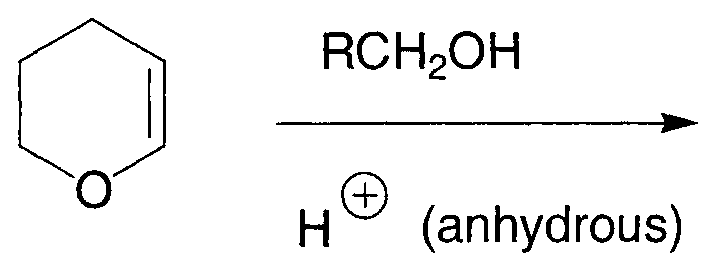
Options
a hemiacetal
an acetal
an ether
an ester
Step-by-Step Solution
To determine the nature of the major product in the given reaction:
-
Reaction Mechanism:
The starting material is 3,4-dihydro-2-pyran (DHP), which contains an enol ether functional group.-
Step 1: Protonation
In the presence of an acid catalyst (, anhydrous), the double bond is protonated at the C-3 position (-carbon relative to the ring oxygen). This forms a highly resonance-stabilized oxocarbenium ion (carbocation at the C-2 position, adjacent to the oxygen atom):
-
Step 2: Nucleophilic Attack
The alcohol () acts as a nucleophile and attacks the electrophilic C-2 carbon of the oxocarbenium ion:
-
Step 3: Deprotonation
Loss of a proton regenerates the acid catalyst () and yields 2-alkoxytetrahydropyran (a THP ether).
-
-
Functional Group Analysis of the Product:
At the C-2 carbon of the tetrahydropyran ring:- It is bonded to the ring oxygen atom ().
- It is bonded to the exocyclic alkoxy group ().
- It is bonded to one hydrogen atom () and one carbon atom from the ring ().
A carbon atom attached to two alkoxy/aryloxy groups ( and ), a hydrogen atom, and an alkyl chain constitutes an acetal (cyclic acetal).
Thus, the major product formed is an acetal.
Correct Option: (B) an acetal