Classification of Pyranose Ring Carbohydrate Structure
The following carbohydrate is
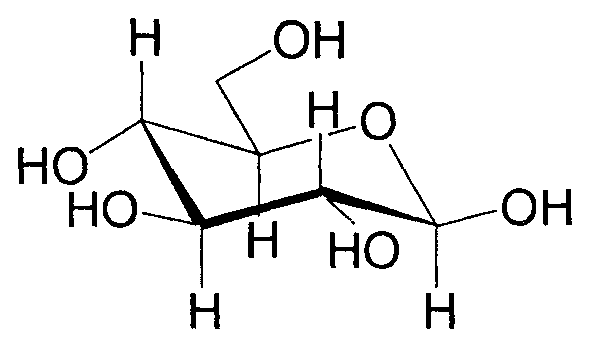
Options
A
a ketohexose
BCorrect
an aldohexose
C
an -furanose
D
an -pyranose
Topics & Concepts
Step-by-Step Solution
To determine the classification of the given carbohydrate, we analyze its chemical structure step-by-step:
-
Identification of Ring Size:
- The ring contains carbon atoms and oxygen atom, forming a six-membered ring known as a pyranose ring. Thus, it cannot be a furanose (a five-membered ring), which eliminates Option C.
-
Analysis of the Anomeric Carbon (C-1):
- The anomeric carbon (C-1) is bonded to a hydroxyl group (), a hydrogen atom (), C-2, and the ring oxygen atom ().
- In a ketohexose (such as D-fructose in its cyclic form), the anomeric carbon (C-2) is attached to a hydroxymethyl group () instead of a single hydrogen atom.
- The presence of a hydrogen atom () directly attached to the anomeric carbon indicates that the original open-chain form contained an aldehyde functional group () at the C-1 position. This confirms that it is an aldose.
-
Counting the Total Number of Carbon Atoms:
- The ring contains carbon atoms (C-1, C-2, C-3, C-4, C-5).
- An additional exocyclic carbon atom is present in the group attached to C-5.
- Total number of carbon atoms = .
- A carbohydrate with 6 carbon atoms is classified as a hexose.
-
Anomeric Configuration ( vs ):
- Looking at the relative positions of the groups at the reference carbon (C-5) and the anomeric carbon (C-1):
- The exocyclic group at C-5 points upwards.
- The anomeric group at C-1 also points in the same relative direction (cis/-configuration).
- Therefore, it is a -anomer, making Option D (-pyranose) incorrect.
- Looking at the relative positions of the groups at the reference carbon (C-5) and the anomeric carbon (C-1):
Combining the aldose functionality and the 6-carbon hexose framework, the carbohydrate is an aldohexose.
Correct Answer: B