JEE Challenger
More from Thermodynamics

Work Done in Cyclic Thermodynamic Processes

Consider one mole of a monatomic ideal gas undergoing two distinct cyclic processes E→F→G→EE \rightarrow F \rightarrow G \rightarrow E and E→F→H→EE \rightarrow F \rightarrow H \rightarrow E, as illustrated in the given PV diagram. Each thermodynamic process involved is purely isochoric, isobaric, isothermal, or adiabatic.

Match the paths specified in List I with the corresponding magnitudes of work done given in List II and choose the correct combination from the options provided.
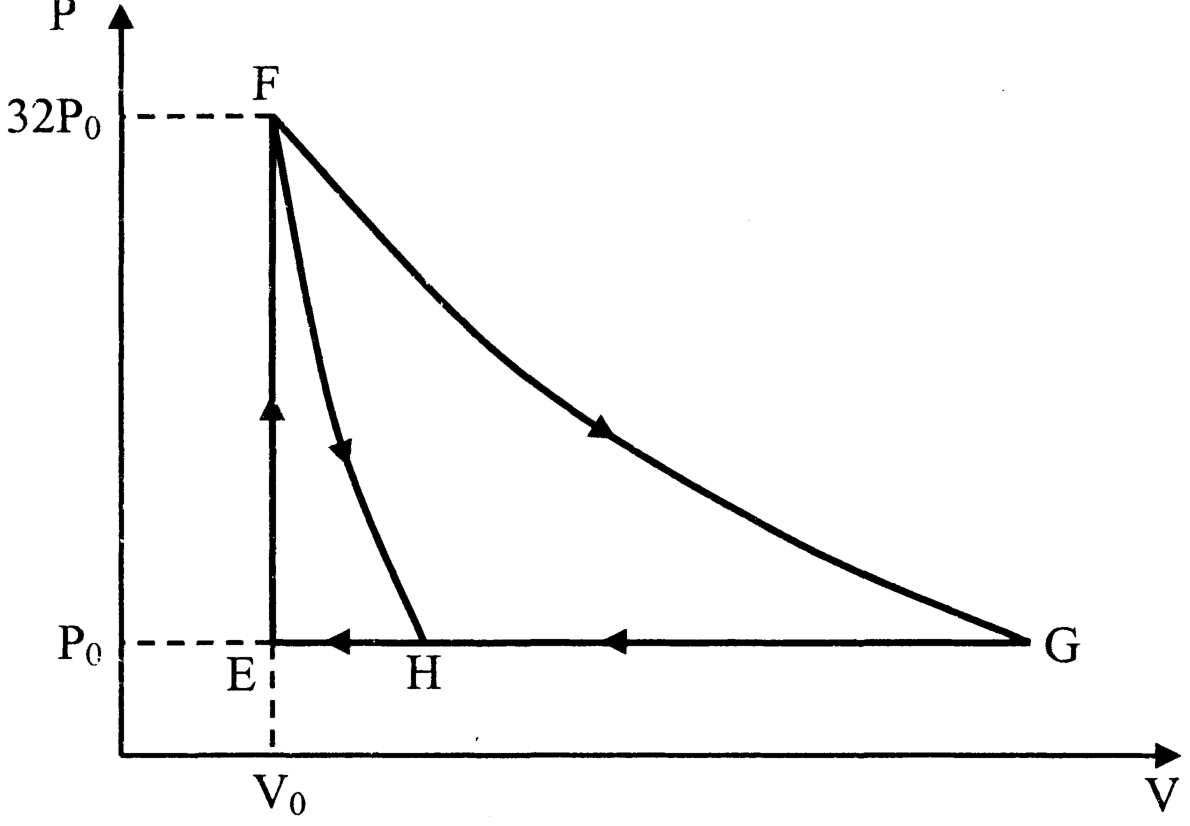
List IList IIP. G→E1. 160P0V0ln⁡2Q. G→H2. 36P0V0R. F→H3. 24P0V0S. F→G4. 31P0V0\begin{array}{ll} \text{List I} & \text{List II} \\ \text{P. } G \rightarrow E & 1.\ 160 P_0 V_0 \ln 2 \\ \text{Q. } G \rightarrow H & 2.\ 36 P_0 V_0 \\ \text{R. } F \rightarrow H & 3.\ 24 P_0 V_0 \\ \text{S. } F \rightarrow G & 4.\ 31 P_0 V_0 \end{array}
Question Diagram 1

Options

A

P-4, Q-3, R-2, S-1

Correct
B

P-4, Q-3, R-1, S-2

C

P-3, Q-1, R-2, S-4

D

P-1, Q-3, R-2, S-4

Step-by-Step Solution

To determine the magnitude of the work done along the paths specified in List I, we first analyze the thermodynamic processes and identify the state parameters at each point:

  1. State of Point EE: PE=P0,VE=V0P_E = P_0, \quad V_E = V_0

  2. State of Point FF: PF=32P0,VF=V0P_F = 32 P_0, \quad V_F = V_0 The path E→FE \rightarrow F is an isochoric process at volume V0V_0.

  3. Identification of Paths F→HF \rightarrow H and F→GF \rightarrow G: Since the gas is monatomic, its ratio of specific heats is γ=53\gamma = \frac{5}{3}. An adiabatic curve on a PVPV diagram has a steeper slope (∣dPdV∣=γPV\left|\frac{dP}{dV}\right| = \gamma \frac{P}{V}) than an isothermal curve (∣dPdV∣=PV\left|\frac{dP}{dV}\right| = \frac{P}{V}).

    • Therefore, the path F→HF \rightarrow H is adiabatic.
    • The path F→GF \rightarrow G is isothermal.
  4. Volumes at HH and GG:

    • For adiabatic path F→HF \rightarrow H: PFVFγ=PHVHγP_F V_F^\gamma = P_H V_H^\gamma (32P0)V05/3=P0VH5/3(32 P_0) V_0^{5/3} = P_0 V_H^{5/3} (VHV0)5/3=32=25  ⟹  VHV0=(25)3/5=8  ⟹  VH=8V0\left(\frac{V_H}{V_0}\right)^{5/3} = 32 = 2^5 \implies \frac{V_H}{V_0} = \left(2^5\right)^{3/5} = 8 \implies V_H = 8 V_0

    • For isothermal path F→GF \rightarrow G: PFVF=PGVGP_F V_F = P_G V_G (32P0)V0=P0VG  ⟹  VG=32V0(32 P_0) V_0 = P_0 V_G \implies V_G = 32 V_0


Step-by-Step Calculation of Work Done:

  • P. Magnitude of work done in path G→EG \rightarrow E: The process G→EG \rightarrow E is isobaric at constant pressure P=P0P = P_0. ∣WG→E∣=P0∣VE−VG∣=P0∣V0−32V0∣=31P0V0|W_{G \rightarrow E}| = P_0 |V_E - V_G| = P_0 |V_0 - 32 V_0| = 31 P_0 V_0 This matches 4 in List II.

  • Q. Magnitude of work done in path G→HG \rightarrow H: The process G→HG \rightarrow H is isobaric at constant pressure P=P0P = P_0. ∣WG→H∣=P0∣VH−VG∣=P0∣8V0−32V0∣=24P0V0|W_{G \rightarrow H}| = P_0 |V_H - V_G| = P_0 |8 V_0 - 32 V_0| = 24 P_0 V_0 This matches 3 in List II.

  • R. Magnitude of work done in path F→HF \rightarrow H: The process F→HF \rightarrow H is adiabatic (γ=53\gamma = \frac{5}{3}). ∣WF→H∣=∣PFVF−PHVHγ−1∣=(32P0)(V0)−(P0)(8V0)53−1=24P0V023=36P0V0|W_{F \rightarrow H}| = \left| \frac{P_F V_F - P_H V_H}{\gamma - 1} \right| = \frac{(32 P_0)(V_0) - (P_0)(8 V_0)}{\frac{5}{3} - 1} = \frac{24 P_0 V_0}{\frac{2}{3}} = 36 P_0 V_0 This matches 2 in List II.

  • S. Magnitude of work done in path F→GF \rightarrow G: The process F→GF \rightarrow G is isothermal. ∣WF→G∣=PFVFln⁡(VGVF)=(32P0V0)ln⁡(32V0V0)=32P0V0ln⁡(25)=160P0V0ln⁡2|W_{F \rightarrow G}| = P_F V_F \ln\left(\frac{V_G}{V_F}\right) = (32 P_0 V_0) \ln\left(\frac{32 V_0}{V_0}\right) = 32 P_0 V_0 \ln(2^5) = 160 P_0 V_0 \ln 2 This matches 1 in List II.


Matching Summary:

  • P →\rightarrow 4
  • Q →\rightarrow 3
  • R →\rightarrow 2
  • S →\rightarrow 1

Thus, the correct option is A.