Vector Addition and Point Partitioning along Directed Segment
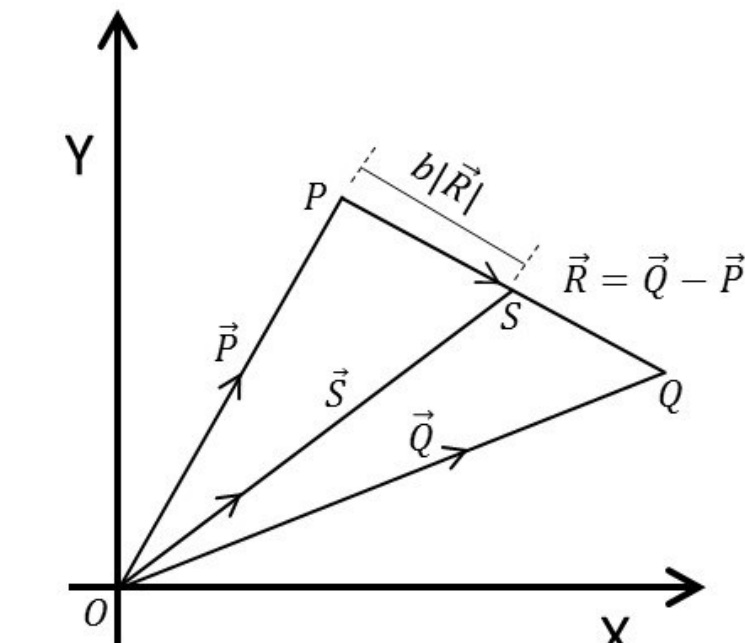
Three vectors , , and are illustrated in the given figure. Let denote a point located on vector . The distance separating points and is given as . Find the general relationship linking the vectors , , and .
Options
Topics & Concepts
Step-by-Step Solution
To find the general relationship linking the vectors , , and , we analyze the position vectors and vector additions from the given diagram.
-
Position Vectors of Points: Let the origin be denoted by . The position vectors of points , , and with respect to the origin are:
-
Vector Representation of : The vector represents the directed line segment from point to point :
-
Displacement Vector from to : Since point lies along the directed line segment (from to ) and the distance between and is given as , the vector is parallel to and its magnitude is times the magnitude of . Therefore, we can write:
-
Determining the Vector : Using vector addition for the triangle :
-
Substituting :
Thus, the correct relation among the vectors is , which corresponds to option A.