Magnetic Field at Center of Star Shaped Wire Loop
A symmetric, star-shaped wire loop carries a steady current as illustrated. The distance between two diametrically opposite vertices of the star is . Find the magnitude of the magnetic field generated at the geometric center of the loop.
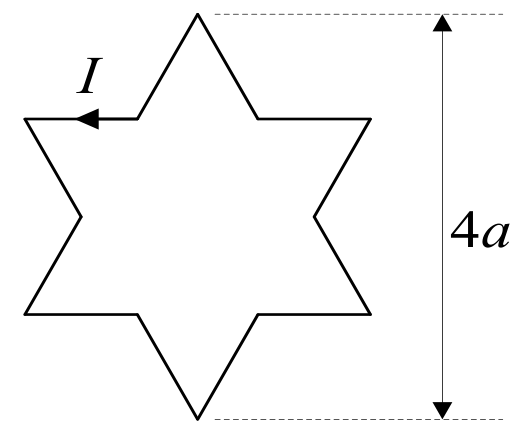
Options
Topics & Concepts
Step-by-Step Solution
To find the magnitude of the magnetic field at the geometric center of the symmetric, 6-pointed star-shaped wire loop, we analyze its geometric properties and apply the Biot-Savart Law.
1. Geometry of the Star Loop
-
Outer Radius (): The distance between two diametrically opposite outer vertices of the star is given as . Thus, the distance from the geometric center to any outer vertex is:
-
Structure of the Loop: A regular 6-pointed star (hexagram) consists of 12 identical straight wire segments, formed by the outer edges of two overlapping equilateral triangles inscribed in a circle of radius .
-
Perpendicular Distance (): Each wire segment lies along a side of one of these equilateral triangles. The perpendicular distance from the center to the line containing any wire segment is:
-
Angles Subtended by a Single Segment: Let be the foot of the perpendicular from the center to the extended line of a wire segment.
- The outer vertex subtends an angle with respect to such that:
- The adjacent inner vertex subtends an angle with respect to such that:
Since both endpoints of the segment ( and ) lie on the same side of the foot of the perpendicular , the field from this single segment is determined by the difference of the sines of these angles.
2. Magnetic Field Due to a Single Segment
Using the Biot-Savart Law for a finite straight conductor, the magnitude of the magnetic field due to one segment at distance is:
Substituting , , and :
3. Total Magnetic Field at the Center
By symmetry, the star consists of 12 such identical wire segments. The current flows in a direction such that the magnetic fields created by all 12 segments at the geometric center point in the same direction (perpendicular to the plane of the loop).
Thus, the total magnetic field is:
Correct Answer:
A