Variation of Stopping Potential with Wavelength and Inverse Wavelength
In a photoelectric effect experiment with incident photon wavelength , the stopping potential is denoted by . Select the correct graphical representation(s) showing the variation of with and .
Options
Topics & Concepts
Step-by-Step Solution
According to Einstein's photoelectric equation, the maximum kinetic energy of the emitted photoelectrons is given by:
where:
- is the stopping potential,
- is the magnitude of charge on an electron,
- is Planck's constant,
- is the speed of light in vacuum,
- is the wavelength of the incident photon,
- is the work function of the metal.
Photoelectric emission takes place only when the incident wavelength is less than or equal to the threshold wavelength (where ).
1. Variation of with :
Rearranging the equation in terms of :
- For , no photoelectrons are emitted, so .
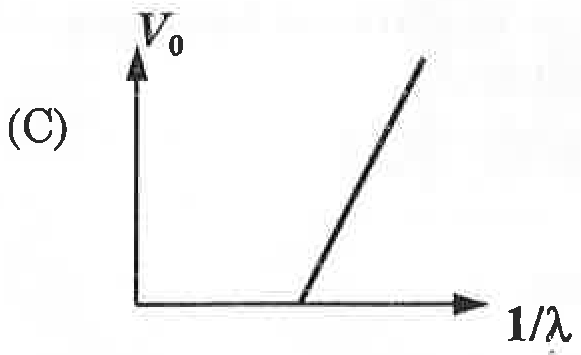
- For , increases linearly with with a positive slope and an intercept on the horizontal axis at .
This linear behavior with a non-zero threshold intercept is correctly represented in graph (C).
2. Variation of with :
Rearranging the equation in terms of :
- For , no photoelectrons are emitted, so .
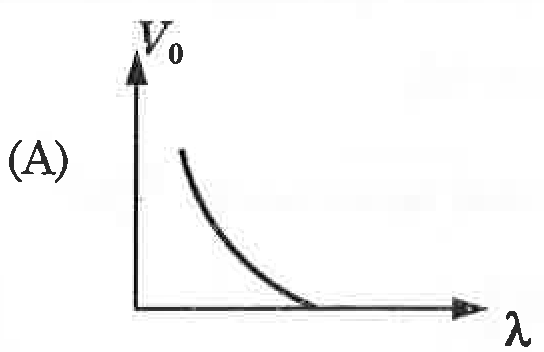
- For , decreases non-linearly as increases.
- Taking the derivatives with respect to :
Since , the curve is convex downwards, decreasing continuously to zero as , and remaining zero for .
This non-linear, concave-upward decaying curve is correctly represented in graph (A).
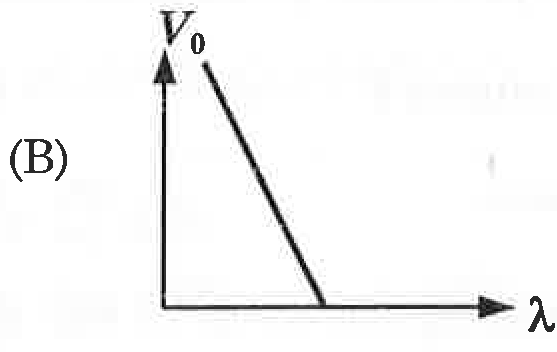
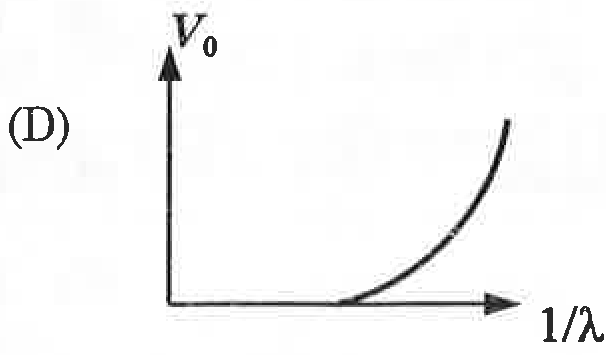
Thus, the correct option(s) are (A) and (C).