JEE Challenger
More from Current Electricity

Electrical Resistance of Composite Aluminum Iron Bar

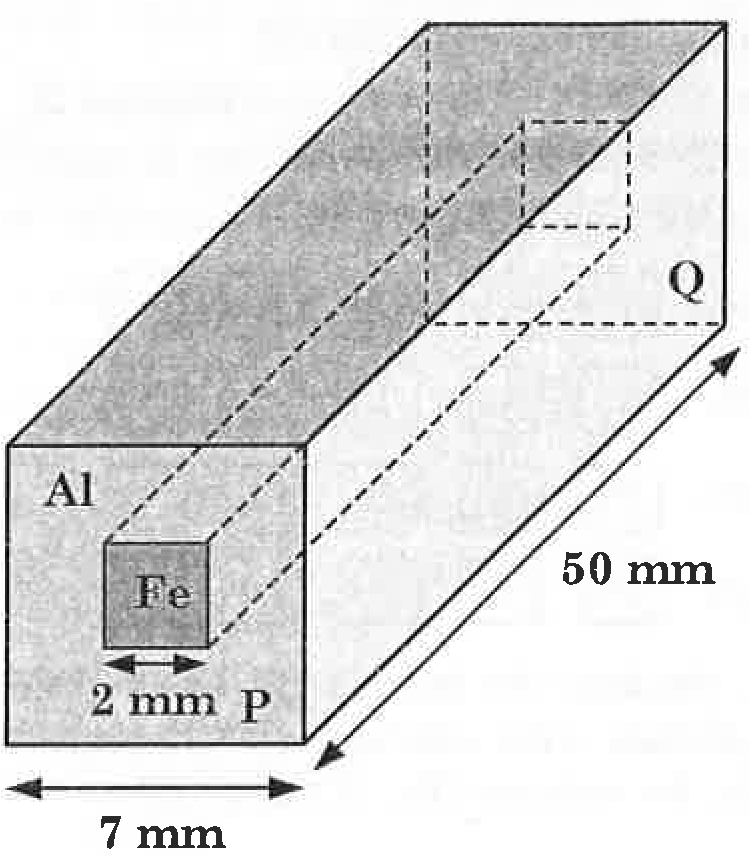
Consider an aluminum (Al) bar having a square cross section. A square hole is made inside it and filled with iron (Fe) as depicted in the figure. The electrical resistivities of Al and Fe are given as 2.7×10⁻⁸ Ω m2.7 \times 10^{-8}\ \Omega\text{ m} and 1.0×10⁻⁷ Ω m1.0 \times 10^{-7}\ \Omega\text{ m}, respectively. Determine the total electrical resistance between the opposite faces P and Q of this composite bar.

Question Diagram 1

Options

A

247564 μΩ\frac{2475}{64}\ \mu\Omega

B

187564 μΩ\frac{1875}{64}\ \mu\Omega

Correct
C

187549 μΩ\frac{1875}{49}\ \mu\Omega

D

2475132 μΩ\frac{2475}{132}\ \mu\Omega

Step-by-Step Solution

To find the total electrical resistance between the opposite faces PP and QQ of the composite bar, we analyze the current flow through the two materials, Aluminum (Al\text{Al}) and Iron (Fe\text{Fe}).

Since the faces PP and QQ serve as the terminal faces across which the voltage is applied, the current flows parallel to the length of the bar. Thus, the Aluminum section and the Iron section act as two resistors connected in parallel.

1. Dimensions and Geometrical Parameters:

  • Length of the bar, L=50 mm=50×10−3 mL = 50\text{ mm} = 50 \times 10^{-3}\text{ m}
  • Cross-sectional area of the inner Iron core (Fe\text{Fe}): AFe=(2 mm)×(2 mm)=4 mm2=4×10⁻⁶ m2A_{\text{Fe}} = (2\text{ mm}) \times (2\text{ mm}) = 4\text{ mm}^2 = 4 \times 10^{-6}\text{ m}^2
  • Total cross-sectional area of the composite bar: Atotal=(7 mm)×(7 mm)=49 mm2=49×10−6 m2A_{\text{total}} = (7\text{ mm}) \times (7\text{ mm}) = 49\text{ mm}^2 = 49 \times 10^{-6}\text{ m}^2
  • Cross-sectional area of the outer Aluminum casing (Al\text{Al}): AAl=Atotal−AFe=(49−4) mm2=45 mm2=45×10−6 m2A_{\text{Al}} = A_{\text{total}} - A_{\text{Fe}} = (49 - 4)\text{ mm}^2 = 45\text{ mm}^2 = 45 \times 10^{-6}\text{ m}^2

2. Resistance of Individual Components:

  • Resistance of the Iron core (RFeR_{\text{Fe}}): RFe=ρFeLAFeR_{\text{Fe}} = \rho_{\text{Fe}} \frac{L}{A_{\text{Fe}}} Substituting ρFe=1.0×10⁻⁷ Ω m\rho_{\text{Fe}} = 1.0 \times 10^{-7}\ \Omega\text{ m}: RFe=(1.0×10⁻⁷ Ω m)×(50×10−3 m)4×10⁻⁶ m2=5×10−94×10−6 Ω=1.25×10⁻³ Ω=1250 μΩR_{\text{Fe}} = \frac{(1.0 \times 10^{-7}\ \Omega\text{ m}) \times (50 \times 10^{-3}\text{ m})}{4 \times 10^{-6}\text{ m}^2} = \frac{5 \times 10^{-9}}{4 \times 10^{-6}}\ \Omega = 1.25 \times 10^{-3}\ \Omega = 1250\ \mu\Omega

  • Resistance of the Aluminum casing (RAlR_{\text{Al}}): RAl=ρAlLAAlR_{\text{Al}} = \rho_{\text{Al}} \frac{L}{A_{\text{Al}}} Substituting ρAl=2.7×10⁻⁸ Ω m\rho_{\text{Al}} = 2.7 \times 10^{-8}\ \Omega\text{ m}: RAl=(2.7×10⁻⁸ Ω m)×(50×10−3 m)45×10−6 m2=1.35×10−945×10−6 Ω=0.03×10⁻³ Ω=30 μΩR_{\text{Al}} = \frac{(2.7 \times 10^{-8}\ \Omega\text{ m}) \times (50 \times 10^{-3}\text{ m})}{45 \times 10^{-6}\text{ m}^2} = \frac{1.35 \times 10^{-9}}{45 \times 10^{-6}}\ \Omega = 0.03 \times 10^{-3}\ \Omega = 30\ \mu\Omega


3. Total Resistance of the Composite Bar:

Since RAlR_{\text{Al}} and RFeR_{\text{Fe}} are in parallel between faces PP and QQ, the equivalent resistance ReqR_{\text{eq}} is given by:

1Req=1RAl+1RFe\frac{1}{R_{\text{eq}}} = \frac{1}{R_{\text{Al}}} + \frac{1}{R_{\text{Fe}}}

Req=RAl⋅RFeRAl+RFeR_{\text{eq}} = \frac{R_{\text{Al}} \cdot R_{\text{Fe}}}{R_{\text{Al}} + R_{\text{Fe}}}

Substituting the calculated values: Req=30×125030+1250 μΩ=375001280 μΩ=3750128 μΩ=187564 μΩR_{\text{eq}} = \frac{30 \times 1250}{30 + 1250}\ \mu\Omega = \frac{37500}{1280}\ \mu\Omega = \frac{3750}{128}\ \mu\Omega = \frac{1875}{64}\ \mu\Omega

Thus, the total electrical resistance of the composite bar is 187564 μΩ\frac{1875}{64}\ \mu\Omega.

Correct Option: (B)