Transverse Wave Pulse Propagation along Hanging Rope
Consider a block hanging vertically from the lower end of a uniform rope with constant linear mass density. The top end of this rope is attached to a fixed support at . A transverse wave pulse (Pulse 1) having wavelength is generated at point on the rope and requires time to reach point . When a similar wave pulse of wavelength is initiated at point (Pulse 2) without altering the position of , it takes time to reach point . Which of the following statements is/are correct?
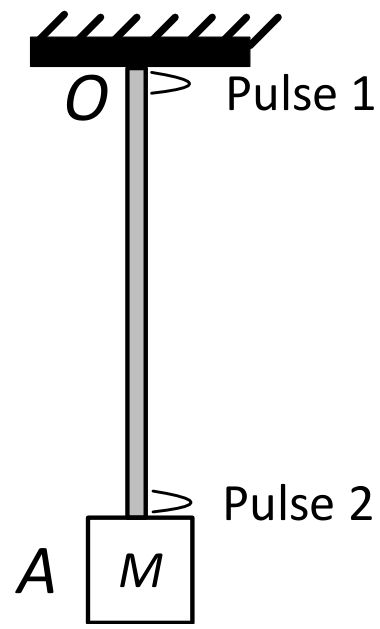
Options
The travel time equals
At the midpoint of the rope, the speed of Pulse 1 equals that of Pulse 2
Upon reaching point , the wavelength of Pulse 1 increases
The velocity of any wave pulse traveling along the rope does not depend on its frequency or wavelength
Topics & Concepts
Step-by-Step Solution
To determine the correct options, let us analyze the mechanics of transverse wave propagation along a hanging uniform rope carrying a suspended block .
1. Tension and Wave Speed along the Rope
Let be the vertical distance measured from the lower end of the rope ( at point and at the top support ).
Let be the uniform linear mass density (mass per unit length) of the rope, and be the acceleration due to gravity. The tension in the rope at a height from the bottom end is given by the sum of the weight of the block and the weight of the segment of the rope below height :
The velocity of a transverse wave pulse at any point on the rope is determined strictly by the local tension and the linear mass density :
2. Analysis of Options
-
Option (A): The time taken by Pulse 1 to travel from to ( to ) is: The time taken by Pulse 2 to travel from to ( to ) is: Since the local speed at any point is independent of the direction of propagation, the two integrals are identical: Thus, Option (A) is correct.
-
Option (B): At the midpoint of the rope (), the speed of both pulses is identical. However, velocity is a vector quantity. Pulse 1 moves vertically downward: Pulse 2 moves vertically upward: Since , the velocities of the two pulses are opposite in direction and therefore not equal. Thus, Option (B) is incorrect.
-
Option (C): The frequency of a wave pulse is determined solely by its source and remains constant as the pulse travels through the medium. The relationship between velocity , frequency , and wavelength is: As Pulse 1 propagates from () to (), the height decreases, which causes the tension and consequently the speed to decrease. Since decreases and remains constant, the wavelength decreases as Pulse 1 approaches point . Thus, Option (C) is incorrect.
-
Option (D): The speed of a transverse wave in a flexible string/rope is given by . This speed is determined entirely by the physical properties of the medium (tension and mass density ) and is completely independent of the frequency or wavelength of the wave pulse. Thus, Option (D) is correct.
Conclusion
The correct statements are A and D.