Motion of Block and Point Mass on Frictionless Surface
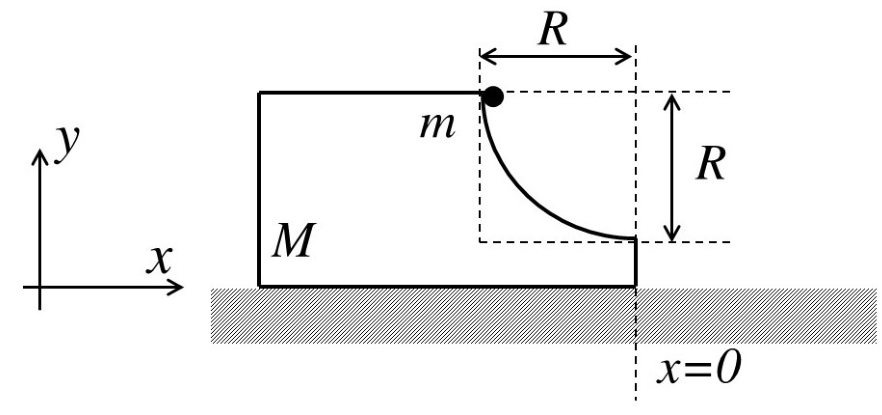
Consider a block of mass with a circular cut featuring a frictionless surface as shown. The block rests on a horizontal frictionless surface of a fixed table. Initially, the right edge of the block is at , in a coordinate system fixed to the table. A point mass is released from rest at the topmost point of the path as shown and slides down. When the mass loses contact with the block, its position is and its velocity is . At that instant, which of the following options is/are correct?
Options
The position of the point mass is given by
The speed of the point mass is given by
The -component of displacement of the center of mass of the block is
The velocity of the block is
Step-by-Step Solution
To determine which options are correct, we analyze the motion of the system consisting of the block of mass and the point mass using the principles of conservation of momentum and conservation of mechanical energy.
1. Analysis of Horizontal Displacement
Since no external force acts on the system along the horizontal () direction, the horizontal component of the position of the center of mass remains unchanged, and the total linear momentum along the -axis is conserved.
Let be the -component of displacement of the block , and be the -component of displacement of the point mass . The condition for zero horizontal displacement of the center of mass gives:
From the given figure:
- Initially, the point mass is at relative to the right edge of the block.
- When slides down to the lowest point of the circular arc and loses contact, its horizontal position relative to the block has moved to the right by a distance equal to the radius .
Therefore, the displacement of mass relative to the block is:
Using the relation for relative displacement, :
Thus, the -component of displacement of the center of mass of the block is . This makes Option C correct.
Now, we calculate the final position of the point mass :
Thus, Option A is incorrect (it incorrectly includes a factor of ).
2. Analysis of Velocities at the Instant of Separation
Let be the horizontal speed of the point mass and be the velocity of the block at the moment mass leaves the track.
By conservation of linear momentum in the horizontal direction:
Since the system is frictionless, mechanical energy is conserved:
Substituting into the energy equation:
Thus, Option B is correct.
Substituting back into the expression for :
Thus, Option D is incorrect.
Conclusion
The correct options are B and C.