Total Number of Intramolecular Aldol Condensation Products
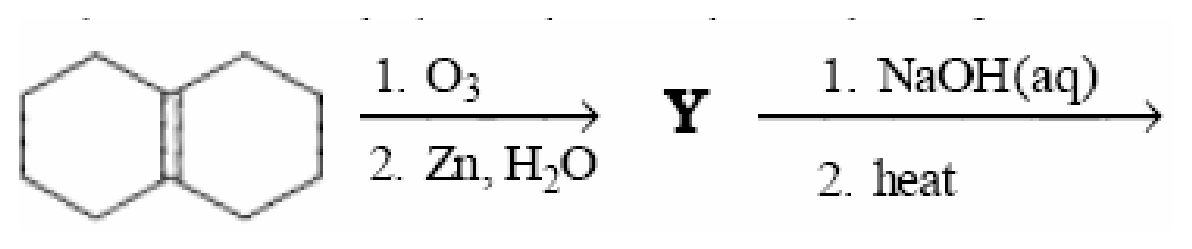
In the reaction, the total number of intramolecular aldol condensation products formed is
Topics & Concepts
Step-by-Step Solution
To find the total number of intramolecular aldol condensation products formed, let us break down the reaction step-by-step:
Step 1: Reductive Ozonolysis
The starting material is -octalin (), which contains a double bond shared between two fused 6-membered rings.
Treatment with ozone () followed by reductive workup with zinc and water () cleaves the central double bond:
Step 2: Intramolecular Aldol Condensation
-
Symmetry Analysis of Compound :
Cyclodecane-1,6-dione is a symmetrical -membered ring diketone containing two carbonyl carbons (C1 and C6) and four -carbon atoms (C2, C5, C7, and C10). Due to the molecular symmetry ( point group), all four -carbon atoms are chemically equivalent. -
Enolate Formation and Nucleophilic Attack:
- Deprotonation at any of the four equivalent -carbons (for instance, C2) by aqueous forms an enolate ion.
- The enolate carbon (C2) attacks the carbonyl carbon at C6 in an intramolecular nucleophilic addition.
- This leads to the formation of a stable -membered ring fused with a -membered ring (a -bicyclic framework).
-
Dehydration:
- Upon heating, the aldol intermediate undergoes dehydration (loss of ) to form a stable -unsaturated ketone: bicyclo[5.3.0]dec-1(7)-en-2-one.
-
Uniqueness of Product:
- Because all four -carbon positions are chemically identical, attacking from C2, C5, C7, or C10 yields the exact same structural molecule.
- Due to ring strain constraints in the 5,7-bicyclic ring system, geometric () isomerism across the double bond is not possible; only the cis-fused double bond geometry exists.
Thus, only 1 intramolecular aldol condensation product is formed.
Final Answer:
The total number of intramolecular aldol condensation products formed is 1.