Total Internal Reflection in Coated Prism for Maximum Incidence Angle
A monochromatic light beam travels from air and strikes a refracting surface of a prism with angle and refractive index . The second refracting surface of the prism is covered with a thin film of a material having refractive index as shown in the diagram. The light beam undergoes total internal reflection at the coated surface for any angle of incidence . The value of is _____.
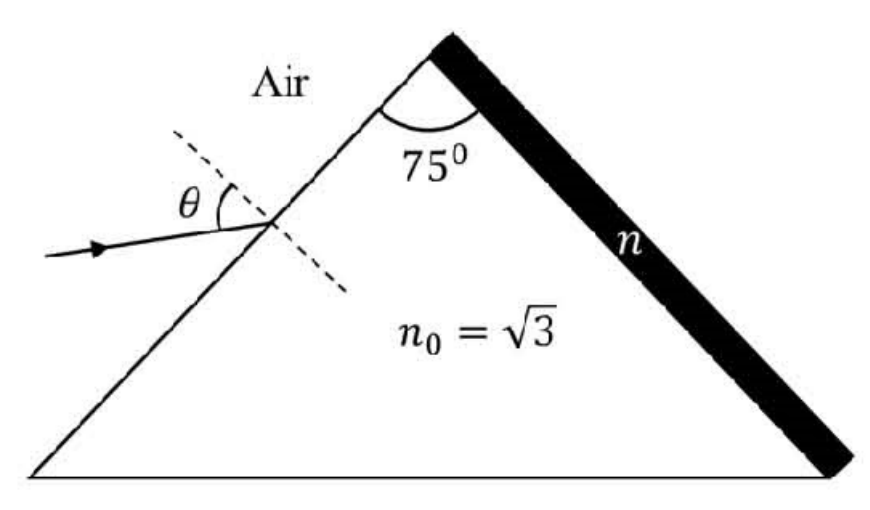
Topics & Concepts
Step-by-Step Solution
To find the value of , we analyze the path of the light ray through the prism step-by-step.
1. Refraction at the First Surface
The light beam is incident from air (refractive index ) onto the first surface of the prism at an angle of incidence .
By Snell's law at the first surface:
Given that the refractive index of the prism is :
2. Angle of Incidence at the Second Surface
For a prism with apex angle , the angles of refraction and inside the prism are related by:
3. Condition for Total Internal Reflection (TIR)
For Total Internal Reflection to occur at the second (coated) surface, the angle of incidence must be greater than or equal to the critical angle between the prism material () and the thin film material ():
The critical angle is given by:
4. Determination of Critical Angle
As the angle of incidence increases:
- increases, which implies increases.
- Consequently, decreases.
Thus, attains its minimum value at the maximum incidence angle .
Since TIR occurs for all , the boundary condition (limiting case for TIR) is reached when . At this angle, must equal the critical angle .
At :
This gives:
The corresponding angle of incidence at the second surface is:
Therefore, the critical angle is:
5. Calculation of
Using the definition of the critical angle:
Squaring both sides gives: