Current in Inductor Circuit with Moving Conducting Wire
A long perfectly conducting wire moves with a constant speed of along a pair of horizontal rails with zero resistance. One end of the rails is connected to an inductor and a resistor as illustrated in the figure. The horizontal rails, , and lie in the same plane inside a uniform magnetic field directed perpendicular into the plane. When the switch is closed at a given moment, the current in the circuit after is , where the value of is _____.
[Assume that the speed of the wire remains constant () after switch is closed. Given: , where is the base of natural logarithm]
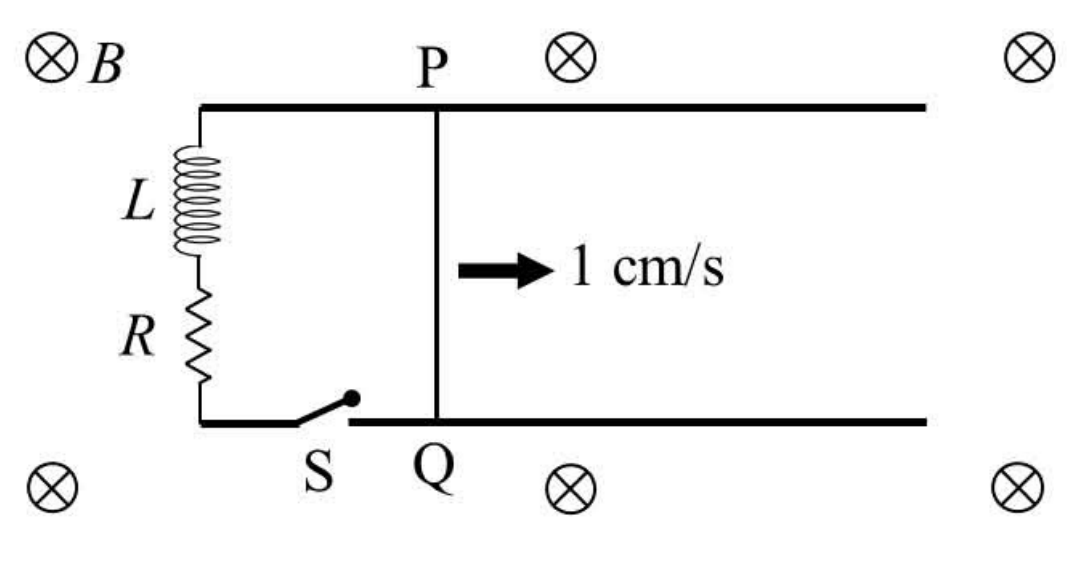
Step-by-Step Solution
When the conducting wire moves with a constant velocity perpendicular to the uniform magnetic field , a motional electromotive force (emf) is induced across its length .
The magnitude of the induced emf is given by:
Given:
- Magnetic field,
- Velocity of wire,
- Length of wire,
Substituting the given values:
By Fleming's Right-Hand Rule (or using ), the induced emf acts such that point is at a higher potential than point . When the switch is closed at , the circuit acts as an circuit connected across a constant DC voltage source of emf .
The differential equation governing the growth of current in the circuit is:
Solving this differential equation with the initial condition , we get the current as a function of time :
Given parameters:
- Resistance,
- Inductance,
- Time,
The time constant of the circuit is:
Since , the exponent simplifies to:
Substituting into the current equation:
Using the given value :
Comparing this with , we obtain: