Total Internal Reflection and Refraction in Two Layered Slab
A wide slab comprising two media with refractive indices and is kept in air as illustrated in the figure. A light ray is incident from medium to medium at an angle , such that is marginally greater than . Assuming the refractive index of air to be 1, identify the correct statement(s):
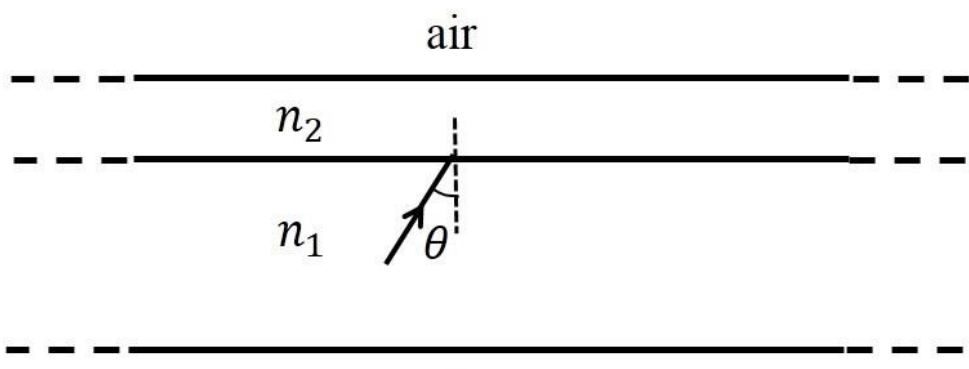
Options
The light ray enters air if
The light ray is finally reflected back into the medium of refractive index if
The light ray is finally reflected back into the medium of refractive index if
The light ray is reflected back into the medium of refractive index if
Topics & Concepts
Step-by-Step Solution
To determine the correct statement(s), we analyze the propagation of the light ray using Snell's Law at each interface.
1. Reflection and Refraction Analysis
Let be the angle of incidence in medium , be the angle of refraction in medium , and be the angle of refraction in air.
Applying Snell's Law at the interface between medium and medium :
Applying Snell's Law at the interface between medium and air ():
Combining these two relations yields:
We are given that , which means:
Therefore:
Since the sine of a real angle cannot exceed , the light ray cannot enter the air under any condition. Thus, total internal reflection (TIR) must occur at one of the boundaries, sending the light ray back into medium .
2. Analysis of the Options
-
Option (A): If , the light ray enters medium without bending (). At the -air interface, , so total internal reflection occurs at the -air interface. The ray is reflected back into medium and subsequently enters medium . Thus, the light ray does not enter air.
(Option A is incorrect) -
Option (B): If , there are two cases:
- If , then . Total internal reflection occurs directly at the - interface, sending the light back into .
- If , the ray enters . However, at the -air interface, , so total internal reflection occurs at the -air interface. The ray then travels back and re-enters medium .
In both scenarios, the light ray is finally reflected back into medium .
(Option B is correct)
-
Option (C): If , since , we have . Thus, , and the ray refracts into medium . At the -air interface, the product , causing total internal reflection. The reflected ray travels back through medium and returns into medium .
(Option C is correct) -
Option (D): If , then . Consequently, total internal reflection occurs immediately at the - interface, and the light ray is reflected back into medium .
(Option D is correct)
Conclusion
The correct options are B, C, and D.