Rolling Motion and Acceleration of Cylinder under Horizontal Force
Consider a horizontal force applied at the center of mass of a cylindrical object with mass and radius , perpendicular to its axis as depicted in the figure. The coefficient of friction with the ground is . The center of mass experiences an acceleration . Let be the acceleration due to gravity. Assuming the object rolls without slipping, select the correct statement(s):
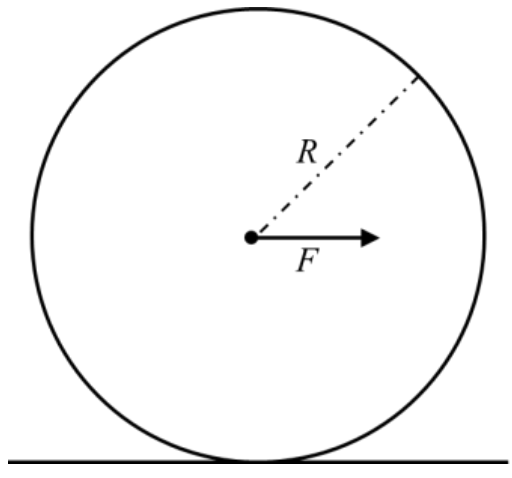
Options
For the same , the value of does not depend on whether the cylinder is solid or hollow
For a solid cylinder, the maximum possible value of is
The magnitude of the frictional force on the object due to the ground is always
For a thin-walled hollow cylinder,
Step-by-Step Solution
To determine the correct statements, let us analyze the dynamics of a cylindrical object of mass , radius , and moment of inertia rolling without slipping on a horizontal surface under the action of a horizontal force applied at its center of mass.
1. Equations of Motion
Let the center of mass have a linear acceleration to the right, and let the cylinder have an angular acceleration in the clockwise direction.
-
Translational Motion: Applying Newton's second law along the horizontal direction: where is the force of static friction acting to the left at the point of contact with the ground.
-
Rotational Motion: Taking torque about the center of mass:
-
Condition for Pure Rolling (Rolling Without Slipping):
From Equation (2) and Equation (3), we get the magnitude of static friction:
Substituting Equation (4) into Equation (1):
Thus, the linear acceleration of the center of mass is given by:
2. Analysis of the Options
-
Option (A):
- For a solid cylinder, :
- For a thin-walled hollow cylinder, : Since , the value of acceleration for a given force depends on whether the cylinder is solid or hollow. Therefore, Option (A) is incorrect.
-
Option (B): For a solid cylinder (), the frictional force from Equation (4) is: For pure rolling without slipping, static friction must satisfy: Hence, the maximum possible acceleration for pure rolling of a solid cylinder is . Therefore, Option (B) is correct.
-
Option (C): The friction force is static in nature and adjusts its value according to . It is equal to only when the cylinder is on the verge of slipping. Therefore, Option (C) is incorrect.
-
Option (D): For a thin-walled hollow cylinder, . Substituting into Equation (5): Therefore, Option (D) is correct.
Conclusion
The correct statements are (B) and (D).