JEE Challenger
More from Electrostatic Potential and Capacitance

Time Constant of Discharging Parallel Plate Capacitor with Decreasing Liquid Level

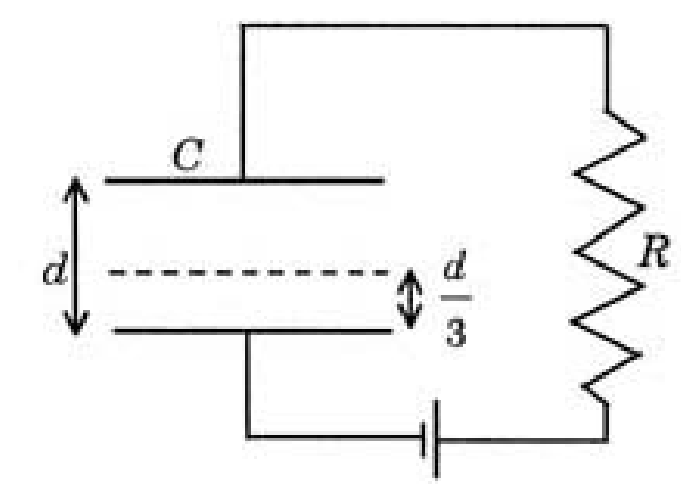
A parallel plate capacitor CC with plates of unit area and separation dd is filled with a liquid of dielectric constant K=2K = 2. The level of liquid is d3\frac{d}{3} initially. Suppose the liquid level decreases at a constant speed VV, the time constant as a function of time tt is

Diagram 0

Options

A

6ε0R5d+3Vt\frac{6\varepsilon_0 R}{5d + 3Vt}

Correct
B

(15d+9Vt)ε0R2d2−3dVt−9V2t2\frac{(15d + 9Vt)\varepsilon_0 R}{2d^2 - 3dVt - 9V^2 t^2}

C

6ε0R5d−3Vt\frac{6\varepsilon_0 R}{5d - 3Vt}

D

(15d−9Vt)ε0R2d2+3dVt−9V2t2\frac{(15d - 9Vt)\varepsilon_0 R}{2d^2 + 3dVt - 9V^2 t^2}

Step-by-Step Solution

To find the time constant of the given circuit as a function of time tt, we need to determine the equivalent capacitance C(t)C(t) of the capacitor at any time tt.

1. Analysis of the Capacitor Geometry

  • The area of the capacitor plates is A=1A = 1.
  • The distance between the parallel plates is dd.
  • The liquid level decreases at a constant speed VV.

At time tt, the thickness of the liquid layer x(t)x(t) is given by:
x(t)=d3−Vtx(t) = \frac{d}{3} - Vt

Consequently, the thickness of the air medium above the liquid is:
d−x(t)=d−(d3−Vt)=2d3+Vtd - x(t) = d - \left(\frac{d}{3} - Vt\right) = \frac{2d}{3} + Vt

2. Equivalent Capacitance Calculation

The liquid medium and the air medium form two dielectric layers oriented parallel to the capacitor plates, which can be modeled as two capacitors connected in series:

  1. Capacitance of the liquid layer (C1C_1):
    C1=Kε0Ax(t)=2ε0(1)d3−VtC_1 = \frac{K \varepsilon_0 A}{x(t)} = \frac{2 \varepsilon_0 (1)}{\frac{d}{3} - Vt}

  2. Capacitance of the air layer (C2C_2):
    C2=ε0Ad−x(t)=ε0(1)2d3+VtC_2 = \frac{\varepsilon_0 A}{d - x(t)} = \frac{\varepsilon_0 (1)}{\frac{2d}{3} + Vt}

Using the formula for series combination of capacitors, 1C=1C1+1C2\frac{1}{C} = \frac{1}{C_1} + \frac{1}{C_2}:
1C(t)=d3−Vt2ε0+2d3+Vtε0\frac{1}{C(t)} = \frac{\frac{d}{3} - Vt}{2\varepsilon_0} + \frac{\frac{2d}{3} + Vt}{\varepsilon_0}

Taking a common denominator 2ε02\varepsilon_0:
1C(t)=(d3−Vt)+2(2d3+Vt)2ε0\frac{1}{C(t)} = \frac{\left(\frac{d}{3} - Vt\right) + 2\left(\frac{2d}{3} + Vt\right)}{2\varepsilon_0}
1C(t)=d3−Vt+4d3+2Vt2ε0=5d3+Vt2ε0\frac{1}{C(t)} = \frac{\frac{d}{3} - Vt + \frac{4d}{3} + 2Vt}{2\varepsilon_0} = \frac{\frac{5d}{3} + Vt}{2\varepsilon_0}
1C(t)=5d+3Vt6ε0\frac{1}{C(t)} = \frac{5d + 3Vt}{6\varepsilon_0}

Inverting this expression gives the equivalent capacitance C(t)C(t):
C(t)=6ε05d+3VtC(t) = \frac{6\varepsilon_0}{5d + 3Vt}

3. Time Constant (τ\tau)

, The time constant τ(t)\tau(t) of an RCRC circuit is defined as:
τ(t)=RC(t)=6ε0R5d+3Vt\tau(t) = R C(t) = \frac{6\varepsilon_0 R}{5d + 3Vt}

Thus, the correct option is A.