Angle of Incidence for Light Beam to Miss Entering Region IV
A light beam is traveling from Region I to Region IV (Refer Figure). The refractive index in Regions I, II, III and IV are , , and , respectively. The angle of incidence for which the beam just misses entering Region IV is
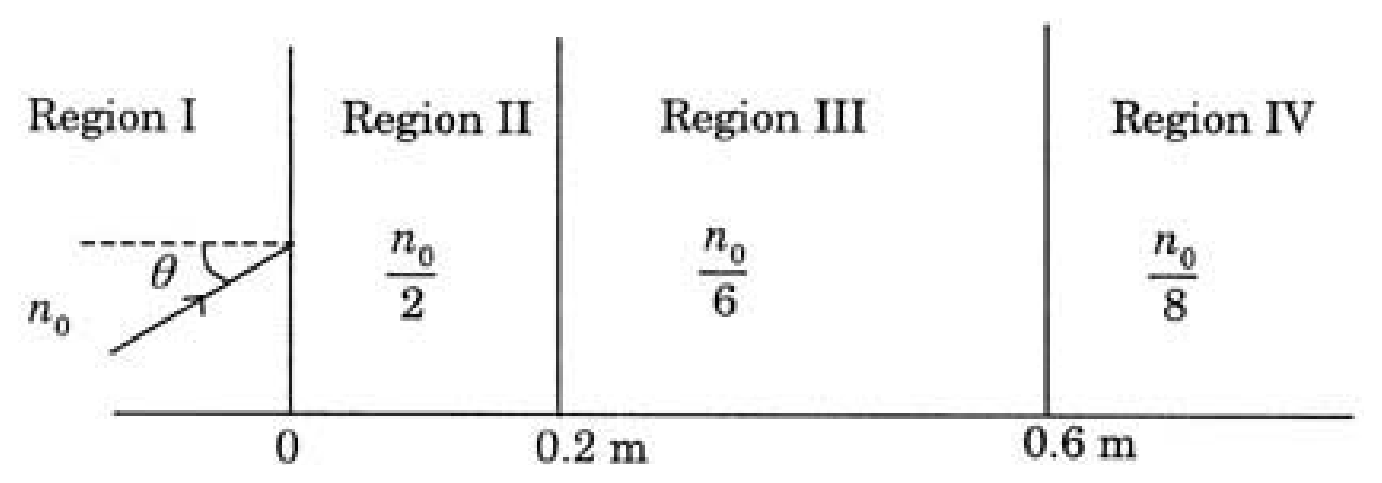
Options
Topics & Concepts
Step-by-Step Solution
To find the angle of incidence in Region I for which the light beam just misses entering Region IV, we analyze the propagation of light across parallel interfaces.
1. Principle of Refraction Across Parallel Media
According to Snell's Law, for a set of parallel planar interfaces, the product of the refractive index of a medium and the sine of the angle of refraction inside that medium relative to the normal remains constant throughout all layers:
2. Condition for "Just Missing" Region IV
For the beam to just miss entering Region IV, total internal reflection (TIR) must occur at the interface between Region III and Region IV. This occurs when the angle of refraction at the boundary becomes (grazing refraction).
Applying Snell's Law directly between Region I and Region IV:
Given:
- Refractive index of Region I,
- Refractive index of Region IV,
- Critical condition angle in Region IV,
Substitute these values into the equation:
Since :
3. Verification for Intermediate Regions
To ensure that the beam actually reaches the Region III–IV interface without experiencing total internal reflection at earlier boundaries:
-
At Region I – Region II Interface:
-
At Region II – Region III Interface:
-
At Region III – Region IV Interface:
Thus, total internal reflection occurs precisely at the boundary of Region IV.
Correct Option: (B)