Thermodynamic State Functions and Work Done Along Different Paths
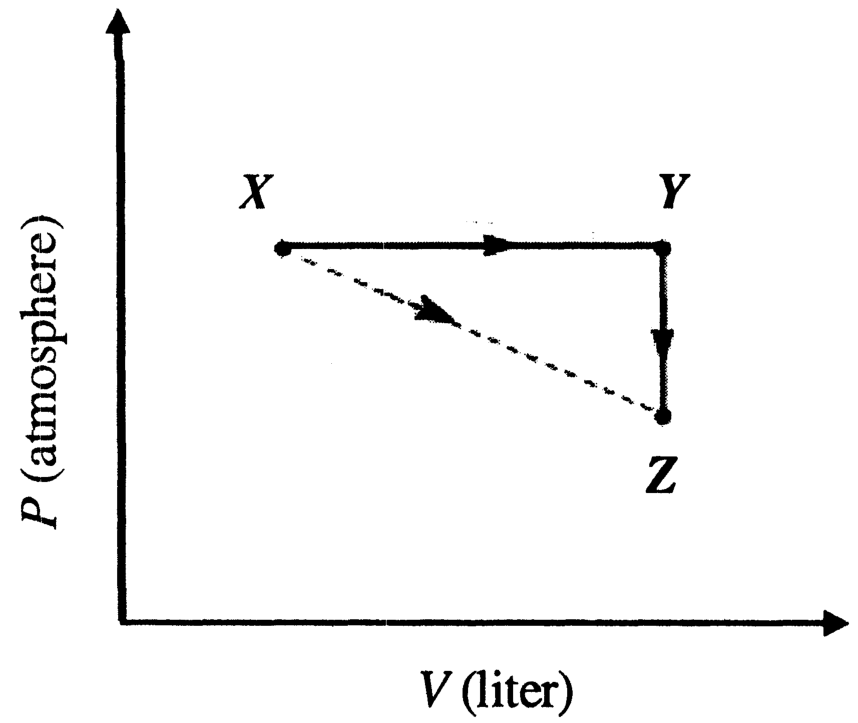
For an ideal gas, consider only work during a transition from an initial state to a final state . State can be reached via either of the two paths depicted in the figure. Which of the following choice(s) is (are) correct? [Let denote entropy change and denote work done]
Options
Topics & Concepts
Step-by-Step Solution
To determine the correct choice(s), we analyze the thermodynamic properties (state functions and path functions) for the given process on the diagram.
1. Entropy Change ()
Entropy () is a state function, which means that the change in entropy between any two state points depends only on the initial and final states, independent of the path taken.
-
For the process occurring along the path , the total entropy change is the sum of entropy changes in each step:
-
Since state is reached in both paths ( and ) starting from the same initial state :
-
Equating the two expressions gives:
Thus, Option (A) is correct.
2. Work Done ()
Work done () is a path function, given by (using IUPAC convention). The magnitude of work corresponds to the area under the curve on a diagram.
-
For the two-step path :
-
Step is an isochoric process (constant volume, ), so no work is done along this step:
-
Substituting :
Thus, Option (C) is correct.
3. Evaluation of Options (B) and (D)
-
Option (B): is the work done along the direct straight-line path . The area under line is less than the area under line (which represents ). Therefore: Hence, Option (B) is incorrect.
-
Option (D): Since and are at different thermodynamic states (different pressures at the same volume), . Therefore: Hence, Option (D) is incorrect.
Conclusion
The correct choices are A and C.