JEE Challenger
More from Thermodynamics

Thermodynamic Cycle with Semi Circle and Ellipse Paths

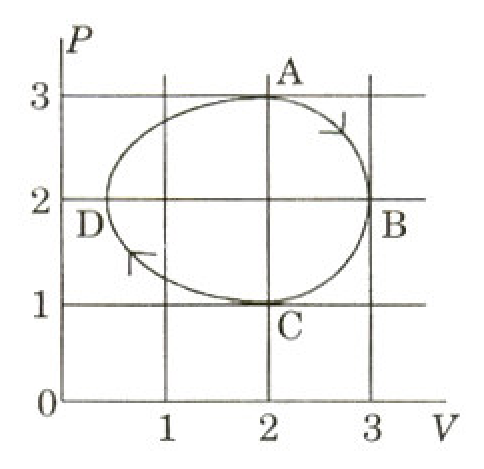
The figure shows the PP-VV plot of an ideal gas taken through a cycle ABCDA\mathrm{ABCDA}. The part ABC\mathrm{ABC} is a semi-circle and CDA\mathrm{CDA} is half of an ellipse. Then,

Diagram 0

Options

A

the process during the path A→B\mathrm{A} \rightarrow \mathrm{B} is isothermal

B

heat flows out of the gas during the path B→C→D\mathrm{B} \rightarrow \mathrm{C} \rightarrow \mathrm{D}

Correct
C

work done during the path A→B→C\mathrm{A} \rightarrow \mathrm{B} \rightarrow \mathrm{C} is zero

D

positive work is done by the gas in the cycle ABCDA\mathrm{ABCDA}

Correct

Step-by-Step Solution

To determine the correct statements, we analyze each option step-by-step using the principles of thermodynamics and the given PP-VV diagram.


1. Analysis of Path A→B\mathrm{A} \rightarrow \mathrm{B} (Option A)

  • From the given diagram, the coordinates in the PP-VV plane are:
    • State A\mathrm{A}: PA=3P_{\mathrm{A}} = 3, VA=2  ⟹  PAVA=6V_{\mathrm{A}} = 2 \implies P_{\mathrm{A}}V_{\mathrm{A}} = 6
    • State B\mathrm{B}: PB=2P_{\mathrm{B}} = 2, VB=3  ⟹  PBVB=6V_{\mathrm{B}} = 3 \implies P_{\mathrm{B}}V_{\mathrm{B}} = 6
  • An isothermal process for an ideal gas satisfies Boyle's Law, PV=constantPV = \text{constant}. If the process were isothermal, the path between A\mathrm{A} and B\mathrm{B} would be a rectangular hyperbola:
    P=6VP = \frac{6}{V}
  • However, the path AB\mathrm{AB} is an arc of a circle centered at (2,2)(2, 2) with radius R=1R = 1:
    (V−2)2+(P−2)2=1(V - 2)^2 + (P - 2)^2 = 1
  • Taking an intermediate state on this arc, for instance where V=2+12≈2.707V = 2 + \frac{1}{\sqrt{2}} \approx 2.707 and P=2+12≈2.707P = 2 + \frac{1}{\sqrt{2}} \approx 2.707:
    PV≈(2.707)2≈7.33≠6PV \approx (2.707)^2 \approx 7.33 \neq 6
    Since the product PVPV (and hence the temperature TT) is not constant along the path, the process is not isothermal.

Therefore, Option A is incorrect.


2. Analysis of Path B→C→D\mathrm{B} \rightarrow \mathrm{C} \rightarrow \mathrm{D} (Option B)

  • According to the First Law of Thermodynamics:
    Q=ΔU+WQ = \Delta U + W

  • Work Done (WW):
    Along the entire path B→C→D\mathrm{B} \rightarrow \mathrm{C} \rightarrow \mathrm{D}, the volume continuously decreases from VB=3V_{\mathrm{B}} = 3 to VC=2V_{\mathrm{C}} = 2, and further to VD<1V_{\mathrm{D}} < 1.
    Since dV<0dV < 0 throughout this path:
    WB→C→D=∫BDP dV<0W_{\mathrm{B} \rightarrow \mathrm{C} \rightarrow \mathrm{D}} = \int_{\mathrm{B}}^{\mathrm{D}} P \, dV < 0

  • Change in Internal Energy (ΔU\Delta U):
    The internal energy of an ideal gas depends solely on temperature:
    ΔU=nCv(TD−TB)=CvR(PDVD−PBVB)\Delta U = n C_v (T_{\mathrm{D}} - T_{\mathrm{B}}) = \frac{C_v}{R} (P_{\mathrm{D}}V_{\mathrm{D}} - P_{\mathrm{B}}V_{\mathrm{B}})
    From the diagram:
    PBVB=2×3=6P_{\mathrm{B}}V_{\mathrm{B}} = 2 \times 3 = 6
    PDVD=2×VD<2×1=2(since VD<1)P_{\mathrm{D}}V_{\mathrm{D}} = 2 \times V_{\mathrm{D}} < 2 \times 1 = 2 \quad (\text{since } V_{\mathrm{D}} < 1)
    Therefore:
    PDVD<PBVB  ⟹  TD<TB  ⟹  ΔUB→D<0P_{\mathrm{D}}V_{\mathrm{D}} < P_{\mathrm{B}}V_{\mathrm{B}} \implies T_{\mathrm{D}} < T_{\mathrm{B}} \implies \Delta U_{\mathrm{B} \rightarrow \mathrm{D}} < 0

  • Heat Transfer (QQ):
    Since both ΔU<0\Delta U < 0 and W<0W < 0:
    Q=ΔU+W<0Q = \Delta U + W < 0
    A negative value of QQ implies that heat flows out of the gas.

Therefore, Option B is correct.


3. Analysis of Work Done during A→B→C\mathrm{A} \rightarrow \mathrm{B} \rightarrow \mathrm{C} (Option C)

  • The work done along path A→B→C\mathrm{A} \rightarrow \mathrm{B} \rightarrow \mathrm{C} is given by the integral:
    WA→B→C=∫ABP dV+∫BCP dVW_{\mathrm{A} \rightarrow \mathrm{B} \rightarrow \mathrm{C}} = \int_{\mathrm{A}}^{\mathrm{B}} P \, dV + \int_{\mathrm{B}}^{\mathrm{C}} P \, dV
  • This equals the area under the curve A→B\mathrm{A} \rightarrow \mathrm{B} minus the area under the curve C→B\mathrm{C} \rightarrow \mathrm{B}, which is geometrically the area enclosed by the semi-circle ABC\mathrm{ABC}:
    WA→B→C=Area of semicircle ABC=πR22=π(1)22=π2>0W_{\mathrm{A} \rightarrow \mathrm{B} \rightarrow \mathrm{C}} = \text{Area of semicircle } \mathrm{ABC} = \frac{\pi R^2}{2} = \frac{\pi (1)^2}{2} = \frac{\pi}{2} > 0
    Hence, the work done is positive and non-zero.

Therefore, Option C is incorrect.


4. Analysis of Work Done in the Cycle ABCDA\mathrm{ABCDA} (Option D)

  • In a PP-VV indicator diagram, the net work done in a cyclic process is equal to the area enclosed by the cycle:
    • If the cycle is traced in a clockwise direction, the work done by the gas is positive (Wnet>0W_{\text{net}} > 0).
    • If the cycle is traced in an anticlockwise direction, the work done by the gas is negative (Wnet<0W_{\text{net}} < 0).
  • Here, the cycle ABCDA\mathrm{ABCDA} is traversed in a clockwise direction. Thus, positive work is done by the gas during the complete cycle:
    Wnet=Area enclosed by ABCDA>0W_{\text{net}} = \text{Area enclosed by } \mathrm{ABCDA} > 0

Therefore, Option D is correct.


Conclusion:

The correct statements are B and D.