Tension in Current Carrying Wire in Uniform Magnetic Field
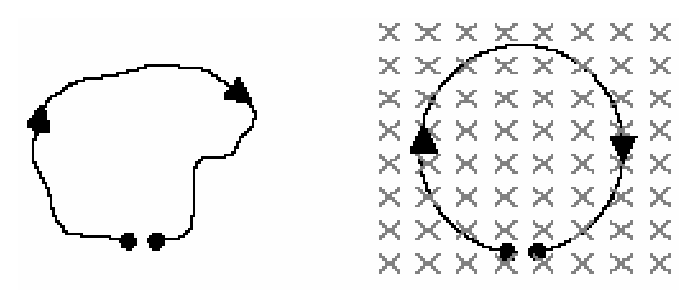
A thin flexible wire of length is connected to two adjacent fixed points and carries a current in the clockwise direction, as shown in the figure. When the system is put in a uniform magnetic field of strength going into the plane of the paper, the wire takes the shape of a circle. The tension in the wire is
Options
Topics & Concepts
Step-by-Step Solution
To find the tension in the current-carrying wire, we analyze the mechanical equilibrium of a small element of the wire.
Let be the radius of the circular loop formed by the wire of length . The relation between the total length and the radius is given by:
Now, consider a small arc element of the wire subtending a small angle at the center of the circular loop. The length of this small element is:
The magnetic force acting on a current element in a uniform magnetic field is given by:
Given that the current flows in the clockwise direction and the magnetic field is directed into the plane of the paper, the direction of is radially outward by the right-hand rule. The magnitude of this magnetic force on the element is:
To oppose this outward radial force and keep the element in equilibrium, the tension acts tangentially at both ends of the arc element.
Resolving the tension forces along the radial direction toward the center, the net inward force due to tension is:
For a very small angle , using the approximation , we get:
For radial equilibrium of the element, the net inward tension force must balance the net outward magnetic force:
Substituting into the expression for tension :
Therefore, the tension in the wire is , corresponding to Option C.