Synthesis of Tertiary Alcohol from Carbonyl and Grignard
Paragraph for Question Nos. 58 to 60
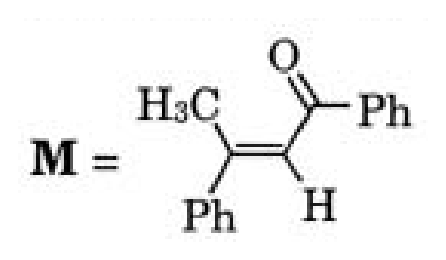
A tertiary alcohol upon acid catalysed dehydration gives a product . Ozonolysis of leads to compounds and . Compound upon reaction with gives benzyl alcohol and a compound , whereas on reaction with gives only .
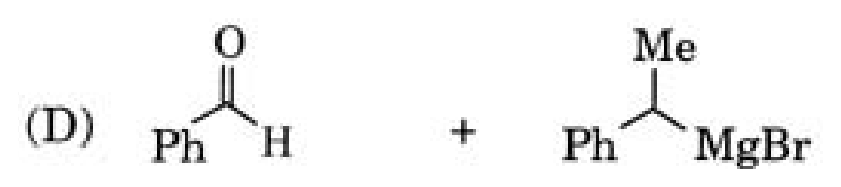
Compound is formed by the reaction of
Options
Step-by-Step Solution
To determine the structure of tertiary alcohol and the reaction that forms it, we analyze the reaction sequence given in the passage:
-
Identification of Compound and :
Compound reacts with to give solely .
From the provided structure, is dypnone:
Dypnone is the aldol condensation product formed by the self-condensation of acetophenone () in the presence of a base:
Therefore, compound is acetophenone, . -
Identification of Compound and :
Compound undergoes reaction with to give benzyl alcohol () and compound . This is the classic disproportionation via the Cannizzaro reaction:
Thus:- is benzaldehyde, .
- is potassium benzoate, .
-
Identification of Alkene :
The passage states that ozonolysis of alkene yields () and ().
Recombining the two carbonyl fragments reveals the structure of alkene :
-
Identification of Tertiary Alcohol :
Acid-catalyzed dehydration of produces the conjugated alkene .
Since is a tertiary alcohol, the hydroxyl group must reside on the tertiary carbon atom:
-
Synthesis of Compound :
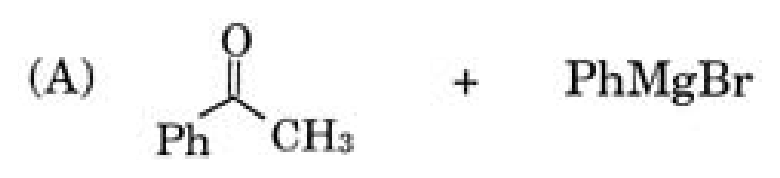
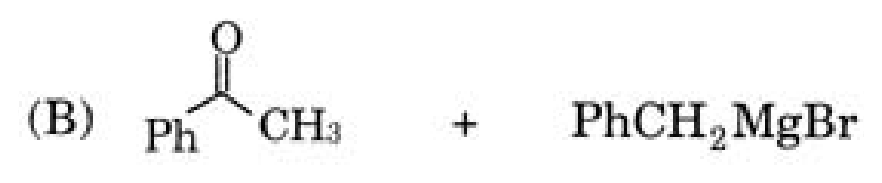
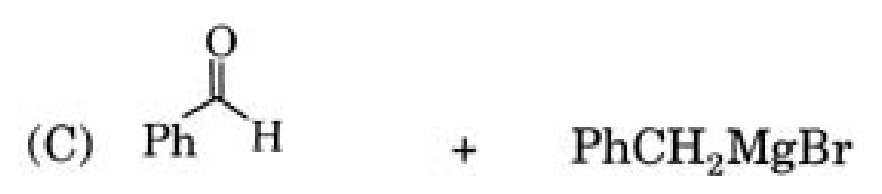
The tertiary alcohol is formed by the nucleophilic addition of benzylmagnesium bromide () to acetophenone (), followed by acidic workup:
This corresponds to Option (B).
Correct Answer: B