Synthesis of Tert Butylbenzene via Electrophilic Aromatic Substitution Reactions
Among the provided chemical reactions, select the one(s) that yield tert-butylbenzene as the major product:
Options
Step-by-Step Solution
To determine which reactions yield -butylbenzene as the major product, we analyze the mechanism of each option:
-
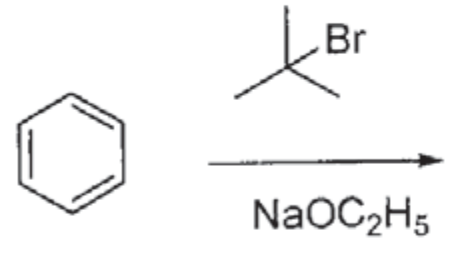
Option (A): When -butyl bromide, , is treated with a strong base like sodium ethoxide (), an elimination reaction predominates over substitution. The major product formed is 2-methylpropene (isobutylene) rather than -butylbenzene. Friedel-Crafts alkylation requires a Lewis acid catalyst (such as ) rather than a strong base. Hence, -butylbenzene is not formed.
-
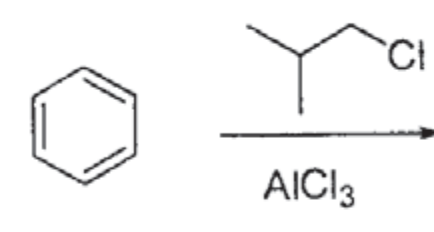
Option (B): Isobutyl chloride, , reacts with to generate an initial primary carbocation-like species: This primary carbocation undergoes a rapid -hydride shift to form the significantly more stable tertiary -butyl carbocation: Electrophilic attack of the -butyl carbocation on benzene gives -butylbenzene as the major product.
-
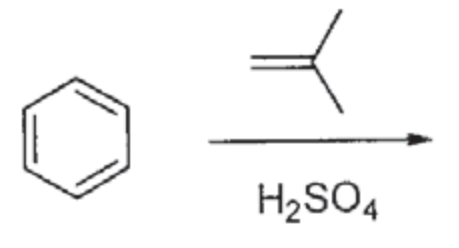
Option (C): Protonation of 2-methylpropene, , by strong acid () generates the stable -butyl carbocation according to Markovnikov's rule: Subsequent electrophilic aromatic substitution on benzene yields -butylbenzene as the major product.
-
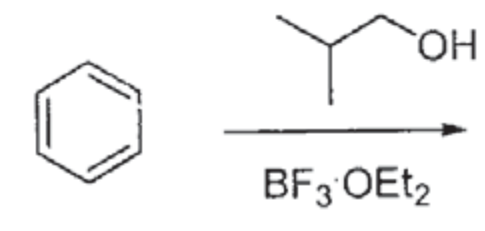
Option (D): Isobutyl alcohol, , reacts with the Lewis acid catalyst . Coordination of to the oxygen atom and departure of the leaving group yields a primary carbocation, which undergoes a -hydride shift to yield the more stable -butyl carbocation: Reaction of this carbocation with benzene yields -butylbenzene as the major product.
Thus, reactions (B), (C), and (D) produce -butylbenzene as the major product.
Correct Answer: B, C, D