Reagent Selection for Selective Reduction of Aldehyde Functionality
Identify the reagent(s) capable of executing the chemical transformation depicted below:
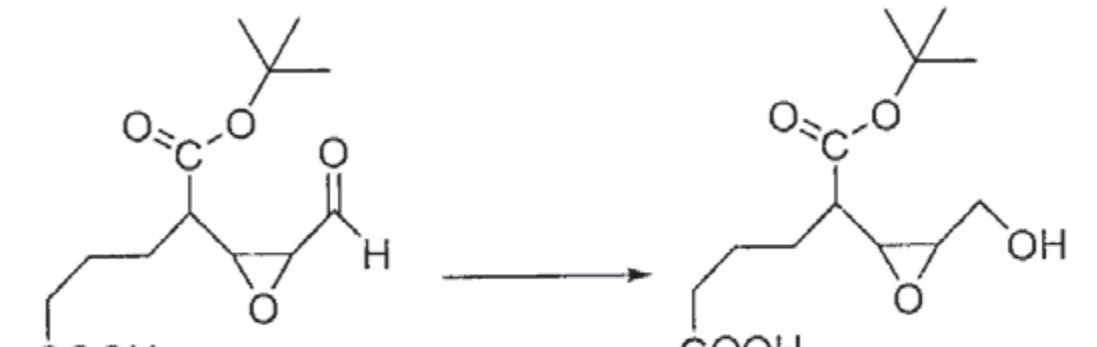
Options
A
in
B
in THF
CCorrect
in
DCorrect
Raney in THF
Step-by-Step Solution
To determine the reagent(s) suitable for the given chemical transformation, we must analyze the structural changes occurring from the reactant to the product:
1. Analysis of Functional Groups
-
Reactant: Contains four functional groups:
- Aldehyde group ()
- Carboxylic acid group ()
- Ester group ()
- Epoxide (oxirane) ring
-
Product:
- The aldehyde group () is selectively reduced to a primary alcohol ().
- The carboxylic acid (), ester (), and epoxide functional groups remain intact/unreacted.
2. Evaluation of Reagents
-
Option (A): in
- is a strong, non-selective reducing agent.
- It reduces aldehydes, carboxylic acids, and esters to alcohols, and opens epoxide rings to form alcohols.
- Therefore, it cannot bring about the desired selective reduction of only the aldehyde group.
- Incorrect.
-
Option (B): in
- Borane () preferentially and rapidly reduces carboxylic acid groups () over aldehydes, esters, and epoxides due to the electrophilic nature of .
- Thus, it would reduce the carboxylic acid group first.
- Incorrect.
-
Option (C): in
- Sodium borohydride () is a mild nucleophilic reducing agent.
- It selectively reduces aldehydes and ketones to alcohols.
- Under standard conditions, does not reduce carboxylic acids, esters, or unfunctionalized epoxides.
- Thus, it selectively reduces the aldehyde group () to a primary alcohol () without affecting the other functional groups.
- Correct.
-
Option (D): Raney in
- Catalytic hydrogenation with Raney under mild conditions selectively reduces the aldehyde () group to a primary alcohol ().
- Carboxylic acids, esters, and epoxide rings are generally resistant to reduction under these mild catalytic conditions.
- Correct.
Conclusion
The reagents capable of executing the given selective reduction are (C) and (D).