Symmetry Elements and Optical Activity of Chiral Dichloro Compound
The correct statement(s) about the compound given below is (are)
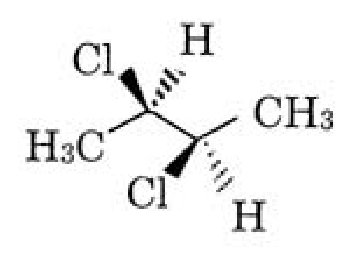
Options
The compound is optically active
The compound possesses centre of symmetry
The compound possesses plane of symmetry
The compound possesses axis of symmetry
Topics & Concepts
Step-by-Step Solution
To determine the correct statements about the given molecule, let us analyze its stereochemistry and symmetry elements:
-
Identification of Stereocenters and Stereoisomer:
The molecule shown is 2,3-dichlorobutane, which has two stereocenters (C2 and C3), each attached to four different groups: , , , and .Determining the absolute configuration of each chiral center:
- For a meso isomer of 2,3-dichlorobutane, the configuration is , which possesses either an internal plane of symmetry () in the eclipsed conformation or an inversion center () in the anti-staggered conformation, making it achiral (optically inactive).
- For the pair of enantiomers, the configurations are and . These enantiomers do not possess any plane of symmetry () or center of inversion () in any conformation. Instead, they possess a two-fold axis of rotation ().
-
Symmetry Elements in the Given Conformation:
- Axis of Symmetry (): A rotation about an axis perpendicular to the central bond passing through its midpoint interchanges the two identical halves of the molecule (, , and ). Thus, the molecule possesses a axis of symmetry.
- Plane of Symmetry (): Reflection across any plane does not yield a superimposable image due to the relative spatial arrangements of the , , and groups.
- Centre of Symmetry (): Inversion through the midpoint of the central bond does not map identical groups onto each other (for example, inverting the wedge does not meet a on the opposite side).
-
Optical Activity:
Because the molecule lacks an improper axis of rotation (specifically, it lacks a plane of symmetry and an inversion center ), it is chiral. Consequently, the compound is optically active.
Therefore:
- (A) The compound is optically active: Correct
- (B) The compound possesses centre of symmetry: Incorrect
- (C) The compound possesses plane of symmetry: Incorrect
- (D) The compound possesses axis of symmetry: Correct
The correct options are A and D.