Relationship Between Keto Enol Forms and Geometric Isomers
The correct statement(s) concerning the structures , and is (are)
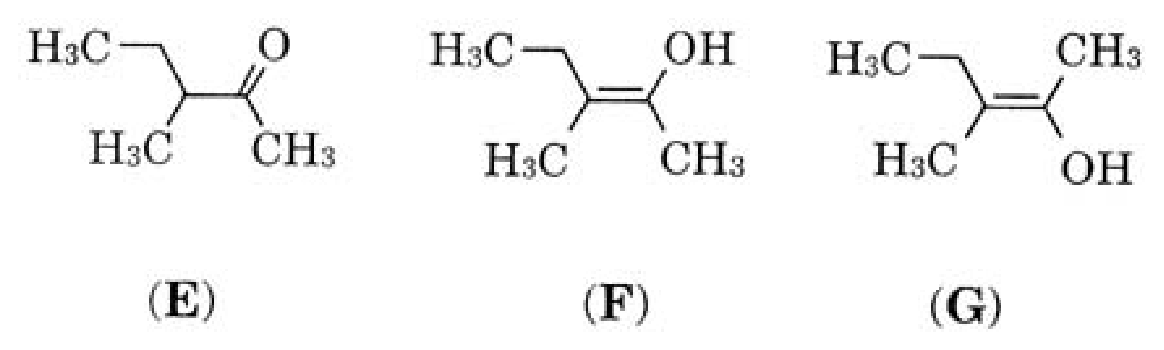
Options
A
, and are resonance structures
BCorrect
, and , are tautomers
CCorrect
and are geometrical isomers
DCorrect
and are diastereomers
Topics & Concepts
Step-by-Step Solution
To determine the correct statements concerning the structures , , and :
-
Relation between , , and (Tautomerism vs Resonance):
- Structure is a ketone (keto form).
- Structures and are enols (enol forms) differing in the connectivity of hydrogen and the position of the double bond:
- Since the interconversion involves the migration of a proton accompanied by a shift of a -bond (change in atomic connectivity), and , as well as and , are tautomers (structural isomers in dynamic equilibrium), not resonance structures (which differ only in electron distribution).
- Therefore, statement (A) is incorrect and statement (B) is correct.
-
Relation between and (Geometrical Isomerism and Diastereomerism):
- Both and are stereoisomers with restricted rotation about the carbon-carbon double bond ().
- In structure , the group and the top substituent are oriented on the same side (or relative spatial arrangement), whereas in , their spatial orientation across the double bond is reversed (one is -isomer and the other is -isomer).
- Because they differ in the spatial arrangement of atoms around the rigid double bond and are non-superimposable non-mirror images, and are geometrical isomers.
- All geometrical isomers that are non-mirror images are, by definition, diastereomers.
- Therefore, statements (C) and (D) are correct.
Thus, the correct statements are B, C, and D.