Structure of Intermediate Compound Q in Alkyne Reaction Sequence
Comprehension Passage
Paragraph for Question Nos. 15 and 16
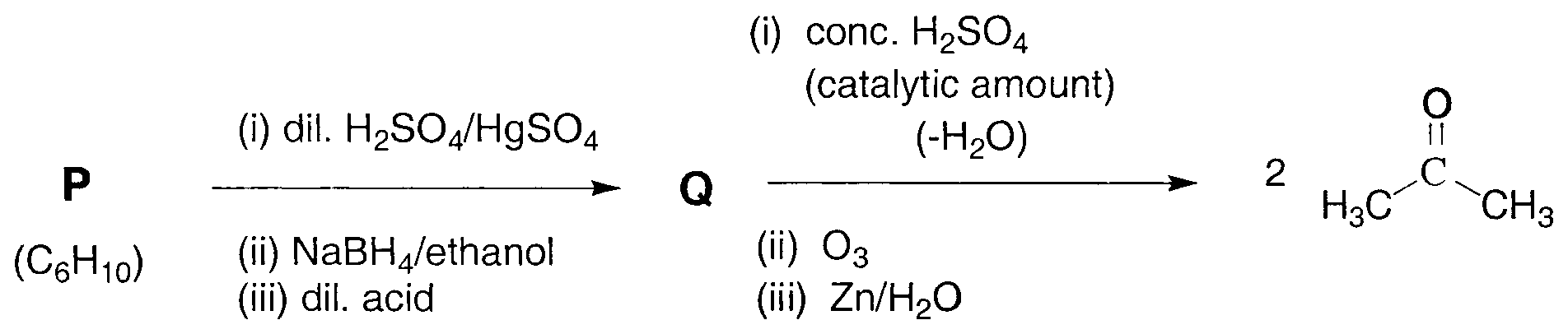
An acyclic hydrocarbon P, having molecular formula C6H10, gave acetone as the only organic product through the following sequence of reactions, in which Q is an intermediate organic compound.
To determine the structure of intermediate compound Q, we trace the given reaction sequence step-by-step:
Hydration of Compound P:
Hydrocarbon P (C6H10) is 3,3-dimethylbut-1-yne, with the formula (CH3)3C−C≡CH.
Reaction of P with dil. H2SO4/HgSO4 results in Markovnikov addition of water across the triple bond to yield an enol intermediate: (CH3)3C−C≡CHdil. H2SO4/HgSO4[(CH3)3C−C(OH)=CH2]
Tautomerization of this enol gives 3,3-dimethylbutan-2-one (pinacolone): [(CH3)3C−C(OH)=CH2]⟶(CH3)3C−C(=O)−CH3
Reduction to Form Compound Q:
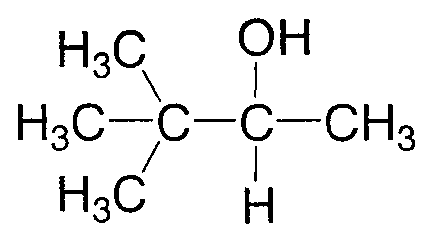
Reduction of 3,3-dimethylbutan-2-one using NaBH4/ethanol followed by workup with dilute acid yields the secondary alcohol, 3,3-dimethylbutan-2-ol: (CH3)3C−C(=O)−CH3(i) NaBH4/ethanol(ii) dil. acid(CH3)3C−CH(OH)−CH3(Q)
Verification via Subsequent Reactions:
Dehydration of Q: Treatment of 3,3-dimethylbutan-2-ol with catalytic conc. H2SO4 leads to protonation and loss of a water molecule, forming a 2∘ carbocation: (CH3)3C−CH(OH)−CH3H+,−H2O(CH3)3C−C+H−CH3
A 1,2-methyl shift takes place to give a more stable 3∘ carbocation: (CH3)3C−C+H−CH31,2-methyl shift(CH3)2C+−CH(CH3)2
Deprotonation then gives 2,3-dimethylbut-2-ene as the major alkene product: (CH3)2C+−CH(CH3)2−H+(CH3)2C=C(CH3)2
Reductive Ozonolysis: Ozonolysis of 2,3-dimethylbut-2-ene (O3 followed by Zn/H2O) cleaves the double bond to produce two molecules of acetone (CH3COCH3): (CH3)2C=C(CH3)2(i) O3(ii) Zn/H2O2 CH3COCH3
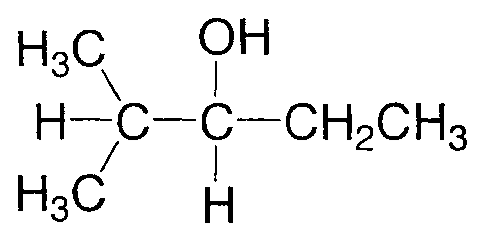
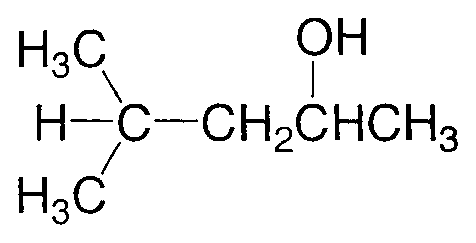
Thus, the structure of compound Q is 3,3-dimethylbutan-2-ol, (CH3)3C−CH(OH)−CH3.