JEE Challenger
More from Hydrocarbons

Identification of Acyclic Hydrocarbon P in Sequential Reactions

Comprehension Passage

Paragraph for Question Nos. 15 and 16

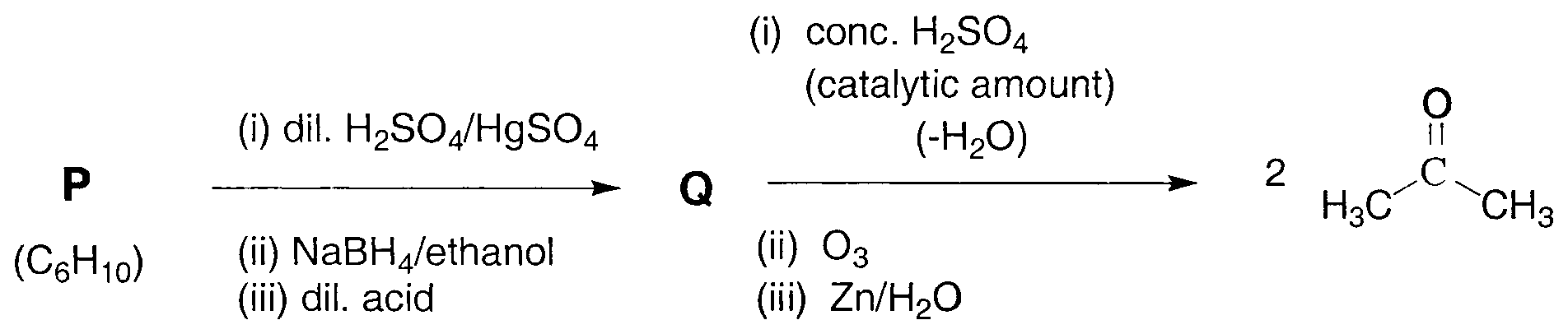
An acyclic hydrocarbon P\mathbf{P}, having molecular formula C6H10\text{C}_6\text{H}_{10}, gave acetone as the only organic product through the following sequence of reactions, in which Q\mathbf{Q} is an intermediate organic compound.

Passage Diagram 0

The structure of compound P\mathbf{P} is

Options

A

CH3CH2CH2CH2−C≡C−H\text{CH}_3\text{CH}_2\text{CH}_2\text{CH}_2-\text{C}\equiv\text{C}-\text{H}

B

H3CH2C−C≡C−CH2CH3\text{H}_3\text{CH}_2\text{C}-\text{C}\equiv\text{C}-\text{CH}_2\text{CH}_3

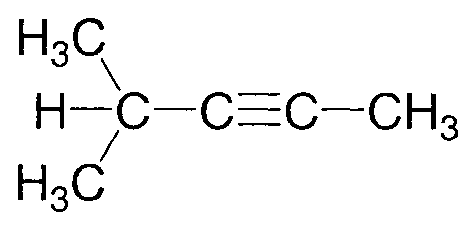
C
Option C Diagram 1
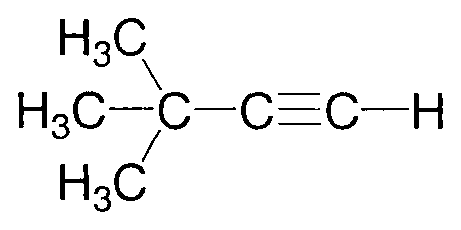
D
Option D Diagram 1
Correct

Step-by-Step Solution

To identify the structure of compound P\mathbf{P}, let us trace the reaction sequence in the reverse direction:

  1. Ozonolysis Product:
    The ozonolysis of the intermediate alkene yields 22 moles of acetone:
    Alkene→(ii) Zn/H2O(i) O32 CH3−C∥O−CH3\text{Alkene} \xrightarrow[\text{(ii) } \text{Zn}/\text{H}_2\text{O}]{\text{(i) } \text{O}_3} 2\text{ CH}_3-\overset{\overset{\text{O}}{\parallel}}{\text{C}}-\text{CH}_3
    Combining the two carbonyl fragments by joining the double bonds gives the symmetrical alkene:
    Alkene=(CH3)2C=C(CH3)2(2,3-dimethylbut-2-ene)\text{Alkene} = (\text{CH}_3)_2\text{C}=\text{C}(\text{CH}_3)_2 \quad (\text{2,3-dimethylbut-2-ene})

  2. Dehydration to form the Alkene (Structure of Intermediate Q\mathbf{Q}):
    2,3-dimethylbut-2-ene is formed via the acid-catalyzed dehydration and carbocation rearrangement of the secondary alcohol Q\mathbf{Q}, which is 3,3-dimethylbutan-2-ol:
    CH3−CH∣OH−C(CH3)3→H+CH3−CH+−C(CH3)3→1,2−CH3 shift(CH3)2CH−C+(CH3)2→−H+(CH3)2C=C(CH3)2\text{CH}_3-\overset{\overset{\text{OH}}{\mid}}{\text{CH}}-\text{C}(\text{CH}_3)_3 \xrightarrow{\text{H}^+} \text{CH}_3-\overset{+}{\text{CH}}-\text{C}(\text{CH}_3)_3 \xrightarrow{1,2-\text{CH}_3\text{ shift}} (\text{CH}_3)_2\text{CH}-\overset{+}{\text{C}}(\text{CH}_3)_2 \xrightarrow{-\text{H}^+} (\text{CH}_3)_2\text{C}=\text{C}(\text{CH}_3)_2

  3. Formation of Q\mathbf{Q} from P\mathbf{P}:
    Compound Q\mathbf{Q} is obtained by Markovnikov hydration of the terminal alkyne followed by reduction with NaBH4\text{NaBH}_4:

    • Hydration of P\mathbf{P} with dil. H2SO4/HgSO4\text{dil. } \text{H}_2\text{SO}_4/\text{HgSO}_4 gives the ketone pinacolone:
      HC≡C−C(CH3)3→dil. H2SO4/HgSO4CH3−C∥O−C(CH3)3\text{HC}\equiv\text{C}-\text{C}(\text{CH}_3)_3 \xrightarrow{\text{dil. } \text{H}_2\text{SO}_4/\text{HgSO}_4} \text{CH}_3-\overset{\overset{\text{O}}{\parallel}}{\text{C}}-\text{C}(\text{CH}_3)_3
    • Reduction of pinacolone with NaBH4/ethanol\text{NaBH}_4/\text{ethanol} gives the alcohol Q\mathbf{Q}:
      CH3−C∥O−C(CH3)3→(ii) H+(i) NaBH4CH3−CH∣OH−C(CH3)3(Q)\text{CH}_3-\overset{\overset{\text{O}}{\parallel}}{\text{C}}-\text{C}(\text{CH}_3)_3 \xrightarrow[\text{(ii) } \text{H}^+]{\text{(i) } \text{NaBH}_4} \text{CH}_3-\overset{\overset{\text{OH}}{\mid}}{\text{CH}}-\text{C}(\text{CH}_3)_3 \quad (\mathbf{Q})

Therefore, the acyclic hydrocarbon P\mathbf{P} is 3,3-dimethylbut-1-yne, (CH3)3C−C≡CH(\text{CH}_3)_3\text{C}-\text{C}\equiv\text{CH}.

This corresponds to Option D.