Stereochemistry of Bromine Addition to Cis and Trans But-2-ene
Identify the correct statement(s) corresponding to the following addition reactions:
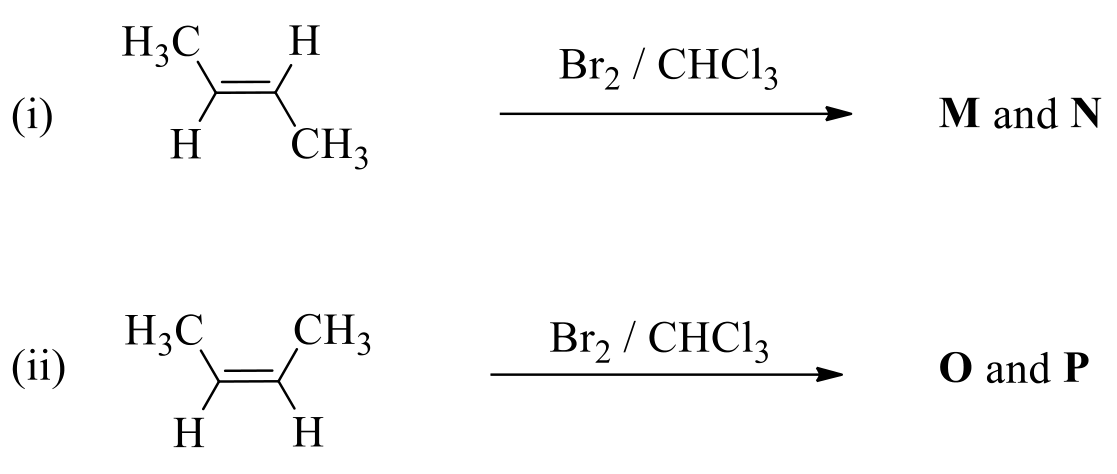
Options
The compounds and are identical molecules
( and ) as well as ( and ) form two pairs of diastereomers
( and ) as well as ( and ) form two pairs of enantiomers
The bromination process proceeds via -addition in both reactions
Topics & Concepts
Step-by-Step Solution
To determine the correct statements, we analyze the mechanism and stereochemistry of the bromination reaction for both alkenes:
1. Reaction Mechanism and Stereospecificity
The addition of bromine () to an alkene in an inert solvent like occurs via electrophilic addition. It involves the formation of a cyclic bromonium ion intermediate, followed by an nucleophilic attack by the bromide ion () from the opposite face.
This leads to an anti-addition (also referred to as -addition) of the two bromine atoms across the double bond. Therefore, Statement (D) is correct.
2. Stereochemical Analysis of Reaction (i)
- Reactant: -but-2-ene
- Addition mode: -addition (anti-addition)
According to the stereochemical mnemonic for addition reactions:
Thus, the reaction produces the optically inactive meso compound, . Hence, and represent the same meso molecule, meaning .
3. Stereochemical Analysis of Reaction (ii)
- Reactant: -but-2-ene
- Addition mode: -addition (anti-addition)
According to the stereochemical mnemonic:
Thus, the reaction produces a pair of enantiomers:
Since and are non-superimposable mirror images (enantiomers), they are not identical. Therefore, Statement (A) is incorrect.
4. Comparison of Product Relationships
- (or ) is the meso stereoisomer: .
- is .
- is .
Since stereoisomers that are not mirror images of each other are diastereomers:
- The pair ( and ) consists of the and forms, which are diastereomers.
- The pair ( and ) consists of the and forms, which are also diastereomers.
Therefore, Statement (B) is correct and Statement (C) is incorrect.
Final Conclusion
The correct statements are B and D.