IUPAC Nomenclature of Substituted Aromatic Hydrocarbon
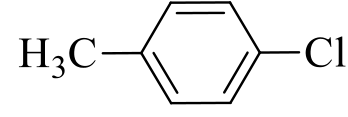
Select the correct IUPAC name(s) for the chemical compound shown below:
Options
ACorrect
1-chloro-4-methylbenzene
BCorrect
4-chlorotoluene
C
4-methylchlorobenzene
D
1-methyl-4-chlorobenzene
Step-by-Step Solution
To determine the correct IUPAC name(s) for the given compound, we analyze its chemical structure:
The compound consists of a benzene ring substituted with a methyl group () and a chlorine atom () at positions para () to each other.
1. Systematic IUPAC Nomenclature (Benzene as Parent)
- When a benzene ring is disubstituted with two non-principal functional groups (both treated as prefixes, i.e., "chloro" and "methyl"), the numbering of the ring is decided by alphabetical order.
- Since "chloro" comes alphabetically before "methyl" ('c' before 'm'):
- The carbon attached to chlorine is assigned locant 1.
- The carbon attached to the methyl group is assigned locant 4.
- Therefore, the systematic IUPAC name is 1-chloro-4-methylbenzene.
2. IUPAC Nomenclature using Retained Names
- IUPAC allows the use of certain retained special names, such as toluene for methylbenzene.
- When toluene is used as the principal parent hydride:
- The carbon atom attached to the methyl group is inherently assigned position 1.
- The chlorine atom attached at the para-position receives locant 4.
- Therefore, another valid IUPAC name is 4-chlorotoluene.
3. Evaluation of Options
- (A) 1-chloro-4-methylbenzene: Correct systematic IUPAC name based on alphabetical locant priority.
- (B) 4-chlorotoluene: Correct IUPAC name using the accepted retained parent name "toluene".
- (C) 4-methylchlorobenzene: Incorrect nomenclature.
- (D) 1-methyl-4-chlorobenzene: Incorrect numbering, because alphabetical priority dictates that "chloro" should receive locant 1 over "methyl".
Thus, the correct options are A and B.