Speed of Block Sliding Down Rough Circular Track
A small block of mass is released from rest at the top of a rough track. The track is a circular arc of radius . The block slides along the track without toppling and a frictional force acts on it in the direction opposite to the instantaneous velocity. The work done in overcoming the friction up to the point , as shown in the figure below, is . (Take the acceleration due to gravity, ).
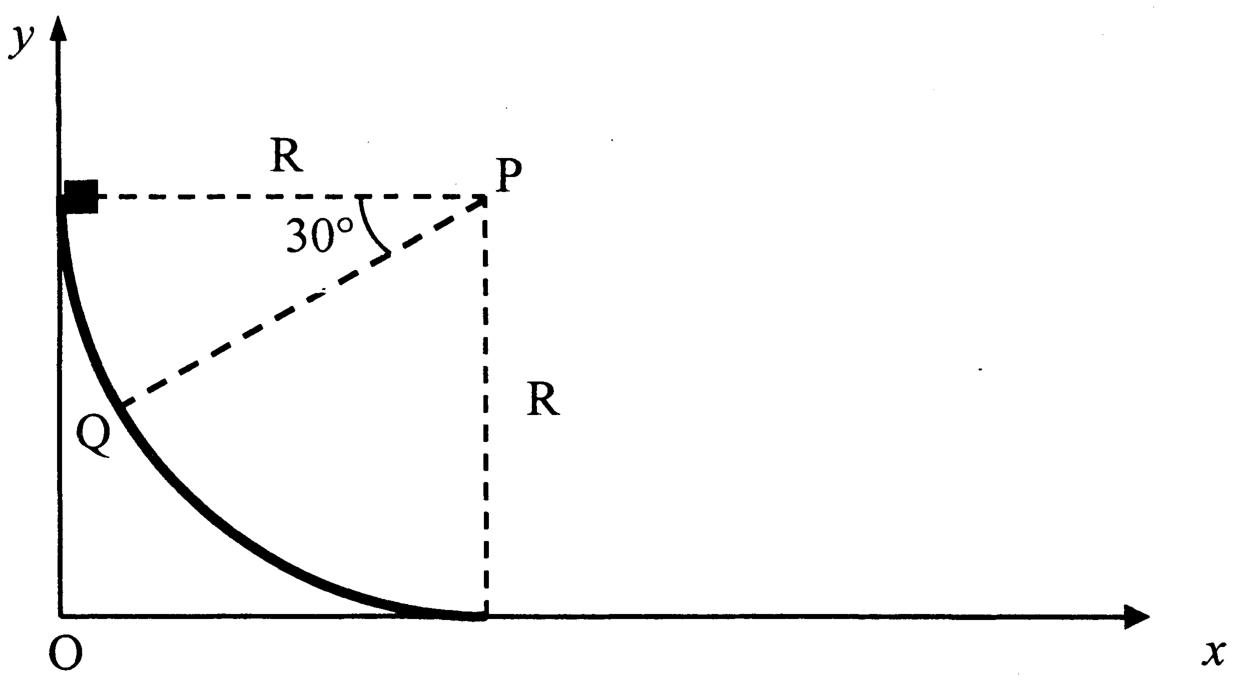
Find the speed of the block upon reaching the point .
Options
Topics & Concepts
Step-by-Step Solution
To find the speed of the block upon reaching point , we apply the Work-Energy Theorem to the block between the top of the track and point .
1. Geometry of the Track and Height Lost
From the given diagram:
- The track is a circular arc of radius .
- The center of the circular arc is at point .
- The block is released from rest at the top of the track, which is located at position , so its initial height is .
- The radius vector makes an angle of below the horizontal line passing through the top of the track and point .
Therefore, the height of point above the ground is:
The vertical height lost by the block when sliding from the top of the track to point is:
2. Work-Energy Theorem
According to the Work-Energy Theorem:
Where:
- is the work done by gravity.
- is the work done by friction (since of work is done in overcoming friction).
- Initial velocity (released from rest).
Substituting the values into the equation:
Conclusion
The speed of the block upon reaching point is .
Correct Option: B