Normal Reaction Acting on Block at Point Q
A small block of mass is released from rest at the top of a rough track. The track is a circular arc of radius . The block slides along the track without toppling and a frictional force acts on it in the direction opposite to the instantaneous velocity. The work done in overcoming the friction up to the point , as shown in the figure below, is . (Take the acceleration due to gravity, ).
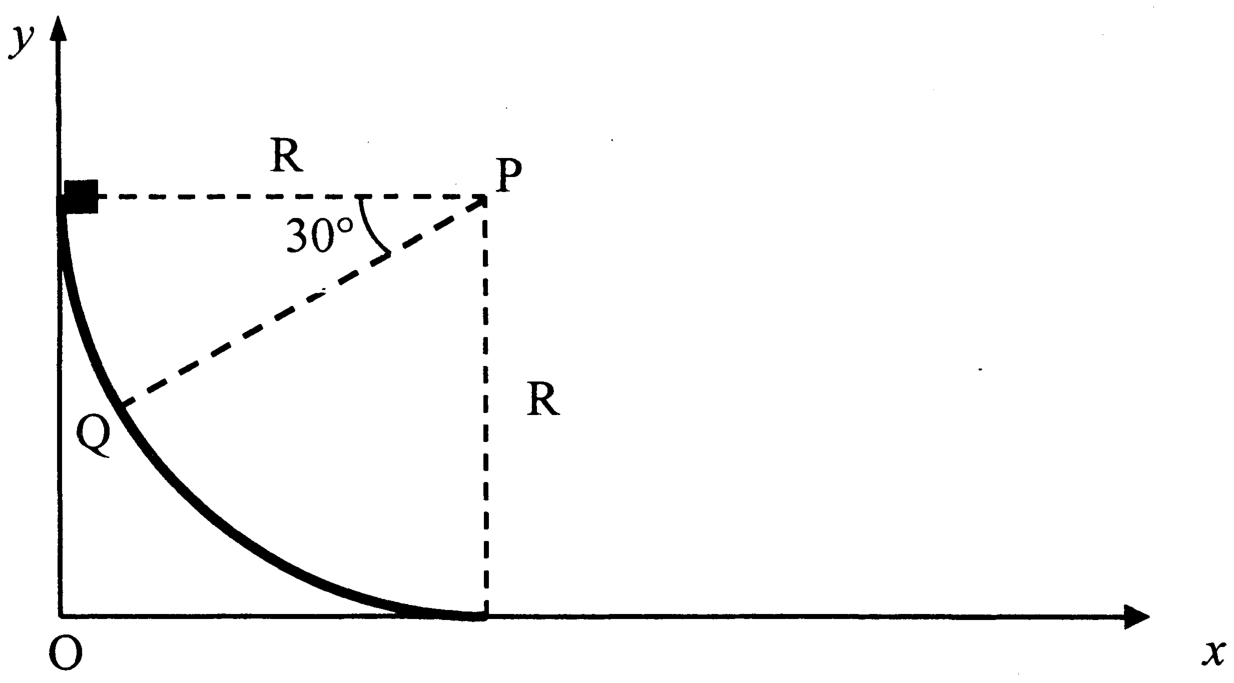
Calculate the magnitude of the normal force exerted on the block at point .
Options
Topics & Concepts
Step-by-Step Solution
To find the magnitude of the normal force exerted on the block at point , we analyze the geometry of the track and apply the principles of circular motion and the Work-Energy Theorem.
Step 1: Geometry of the Track and Position of Point
The circular track has a radius with its center located at .
-
At the top of the track, the block starts from rest at height .
-
Point lies on the circular arc such that the radius vector makes an angle of below the horizontal line .
-
The vertical coordinate of point is given by:
-
Thus, the vertical distance fallen by the block from the top to point is:
Step 2: Determination of Speed at Point
By the Work-Energy Theorem, the total work done on the block as it moves from the top to point equals the change in its kinetic energy:
Given:
- Mass
- Work done against friction is , so
Substituting these values into the equation:
Step 3: Calculation of Normal Force at Point
At point , the forces acting on the block along the radial direction (towards the center ) are:
- The normal force directed radially inwards towards .
- The radial component of gravity pointing radially outwards away from , given by .
The net force directed towards the center provides the required centripetal force for circular motion:
Rearranging to solve for :
Substituting the known values:
Thus, the magnitude of the normal force exerted on the block at point is .