Small Oscillations of an Electric Dipole Near a Uniformly Charged Spherical Shell
A small electric dipole , having a moment of inertia about its center, is kept at a distance from the center of a spherical shell of radius . The surface charge density is uniformly distributed on the spherical shell. The dipole is initially oriented at a small angle as shown in the figure. While staying at a distance , the dipole is free to rotate about its center.
If released from rest, then which of the following statement(s) is(are) correct?
[ is the permittivity of free space.]
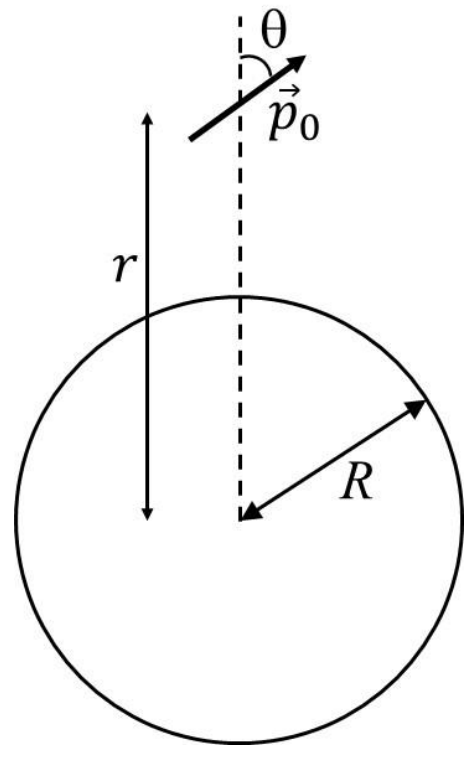
Options
The dipole will undergo small oscillations at any finite value of .
The dipole will undergo small oscillations at any finite value of .
The dipole will undergo small oscillations with an angular frequency of at .
The dipole will undergo small oscillations with an angular frequency of at .
Topics & Concepts
Step-by-Step Solution
To determine the correct statements regarding the small oscillations of the electric dipole, we analyze the electric field due to the uniformly charged spherical shell and the torque acting on the dipole.
1. Electric Field of the Spherical Shell
A spherical shell of radius with uniform surface charge density has a total charge given by:
Using Gauss's Law, the electric field at a distance from the center of the shell is:
-
Inside the shell ():
-
Outside the shell (): where is the unit radial vector directed outward from the center of the shell.
2. Dynamics of the Electric Dipole
When a small electric dipole of dipole moment is kept at a distance and oriented at a small angle with respect to the radial line, it experiences a torque given by:
The magnitude of the restoring torque tending to align the dipole back with the electric field line is:
For small angular displacements (), we use the approximation :
Using Newton's second law for rotation about the center of the dipole:
This is the standard equation of Simple Harmonic Motion (SHM):
where the angular frequency is given by:
3. Evaluation of Options
-
For : Since , the torque on the dipole is zero (). Hence, there is no restoring force, and the dipole will not oscillate.
- Option (A) states that the dipole will undergo small oscillations at any finite value of , which is incorrect because it fails for .
-
For : Since , a non-zero restoring torque acts on the dipole, causing it to undergo small oscillations for any finite value of .
- Option (B) is correct.
-
At : Substituting into the expression for electric field:
The angular frequency becomes:
- Option (C) gives an angular frequency of , which is incorrect.
-
At : Substituting into the expression for electric field:
The angular frequency becomes:
- Option (D) is correct.
Conclusion
The correct statements are (B) and (D).