Equilibrium Angle of Circular Wire Loop in Magnetic Field
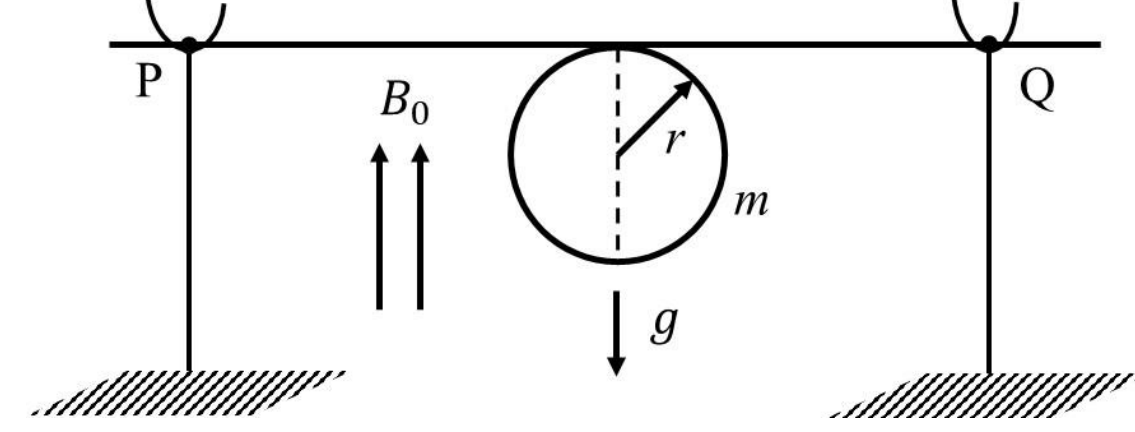
A thin stiff insulated metal wire is bent into a circular loop with its two ends extending tangentially from the same point of the loop. The wire loop has mass and radius and it is in a uniform vertical magnetic field , as shown in the figure. Initially, it hangs vertically downwards, because of acceleration due to gravity , on two conducting supports at P and Q. When a current is passed through the loop, the loop turns about the line PQ by an angle given by
Options
Topics & Concepts
Step-by-Step Solution
To find the angle by which the circular loop turns about the line , we analyze the equilibrium of torques acting on the loop about the axis of rotation .
1. Gravitational Torque ()
The circular loop has mass and radius . Since the upper tangent of the loop lies along the horizontal axis , the center of mass of the loop is at a perpendicular distance from the axis .
When the loop rotates about by an angle , the center of mass moves such that the line connecting to the center of mass makes an angle with the vertical. The magnitude of the restoring gravitational torque about the line is:
2. Magnetic Torque ()
The area vector of the circular loop has magnitude and is directed normal to the plane of the loop.
Let be along the -axis and the vertical direction be along the -axis, so the magnetic field is .
Initially, when the loop hangs vertically, the normal vector points along the horizontal -axis (). When the loop rotates by an angle about the -axis, the normal vector becomes:
The magnetic dipole moment of the loop is:
The magnetic torque acting on the loop is given by :
Thus, the magnitude of the magnetic torque about the line is:
3. Rotational Equilibrium
For the loop to be in equilibrium at an angle , the magnitude of the gravitational torque must equal the magnitude of the magnetic torque:
Rearranging the terms to find :
Thus, the correct option is (A).