SHM of Charged Block in Uniform Electric Field
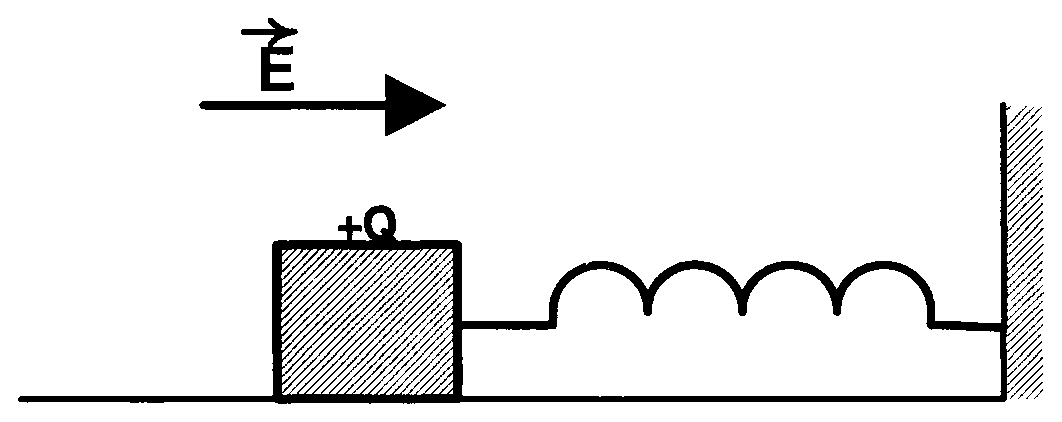
A wooden block performs SHM on a frictionless surface with frequency, . The block carries a charge on its surface. If now a uniform electric field is switched-on as shown, then the SHM of the block will be
Options
of the same frequency and with shifted mean position.
of the same frequency and with the same mean position.
of changed frequency and with shifted mean position.
of changed frequency and with the same mean position.
Topics & Concepts
Step-by-Step Solution
To analyze the Simple Harmonic Motion (SHM) of the wooden block, let us consider the forces acting on it before and after the electric field is applied.
1. Before the Electric Field is Applied:
Let be the mass of the wooden block and be the spring constant of the spring. The equation of motion for the block executing SHM about its natural length (mean position ) is:
The angular frequency and the natural frequency of the oscillation are given by:
2. After the Electric Field is Applied:
When a uniform electric field directed horizontally to the right is switched on, an additional constant electrostatic force acts on the charge :
The net force acting on the block at a displacement from the uncompressed state of the spring becomes:
Thus, the differential equation of motion is:
Rearranging the terms:
3. Shift in Mean Position:
At the new equilibrium (mean) position, the net force on the block is zero:
Thus, the mean position shifts to the right by a distance of .
4. Frequency of Oscillation:
Let represent the displacement from the new mean position. Differentiating twice with respect to time gives:
Substituting this back into the equation of motion yields:
This is the standard equation of Simple Harmonic Motion. The new angular frequency and frequency are:
Since a constant force does not alter the effective force constant or mass , the frequency of oscillation remains unchanged, while the mean position is shifted.
Conclusion:
The SHM of the block will be of the same frequency and with shifted mean position.
Correct Option: A