Equilibrium of Connected Spheres Immersed in Fluid
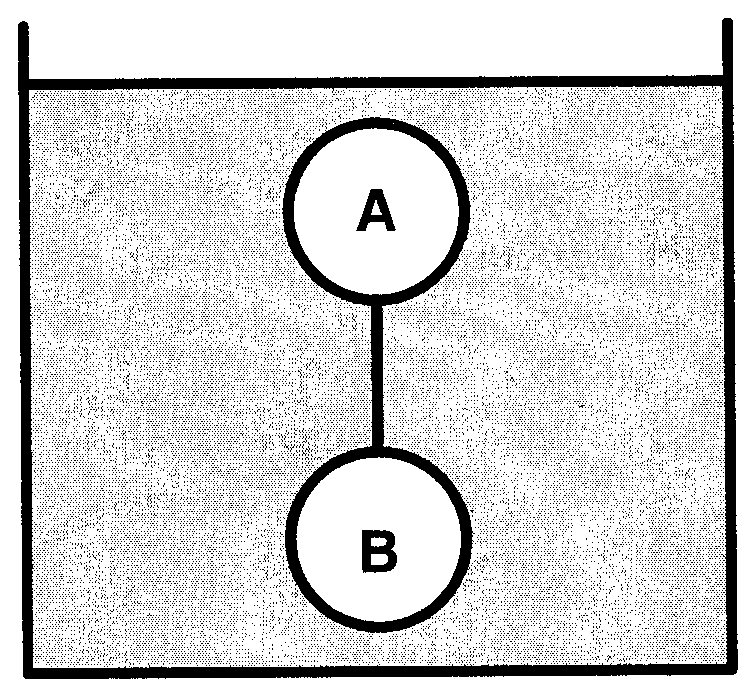
Two solid spheres A and B of equal volumes but of different densities and are connected by a string. They are fully immersed in a fluid of density . They get arranged into an equilibrium state as shown in the figure with a tension in the string. The arrangement is possible only if
Options
Topics & Concepts
Step-by-Step Solution
To determine the conditions for the system of two solid spheres and to remain in static equilibrium fully immersed in a fluid, we analyze the forces acting on each sphere individually and on the combined system.
Let:
- be the volume of each sphere (given that both have equal volumes).
- and be the densities of spheres and , respectively.
- be the density of the fluid.
- be the tension in the string connecting the two spheres.
- be the acceleration due to gravity.
1. Equilibrium of Sphere A (Upper Sphere)
The forces acting on sphere are:
- Upward buoyant force:
- Downward gravitational force (weight):
- Downward tension force exerted by the string:
For sphere to be in equilibrium:
For the string to be taut and under tension, we must have :
Hence, option (A) is correct.
2. Equilibrium of Sphere B (Lower Sphere)
The forces acting on sphere are:
- Upward buoyant force:
- Upward tension force exerted by the string:
- Downward gravitational force (weight):
For sphere to be in equilibrium:
For the tension to be strictly positive ():
Hence, option (B) is correct.
3. Equilibrium of the Combined System (Spheres A + B)
For the entire system suspended in the fluid without accelerating vertically, the total buoyant force must equal the total weight of both spheres:
Hence, option (D) is correct.
Conclusion
The arrangement shown is possible with a non-zero tension in the string if and only if:
Correct Options: A, B, D