Separation Between Colliding Blocks and Oscillating Spring System
A spring-block system rests on a frictionless horizontal floor, as depicted in the diagram. The spring has a force constant of , and the attached block has a mass of . Neglect the mass of the spring. The spring is initially in an unstretched state. A second block of mass approaching with a speed of undergoes an elastic collision with the block attached to the spring. During the subsequent motion, the block does not strike the wall. Find the separation distance, in metres, between the two blocks at the moment the spring first returns to its unstretched position following the collision.
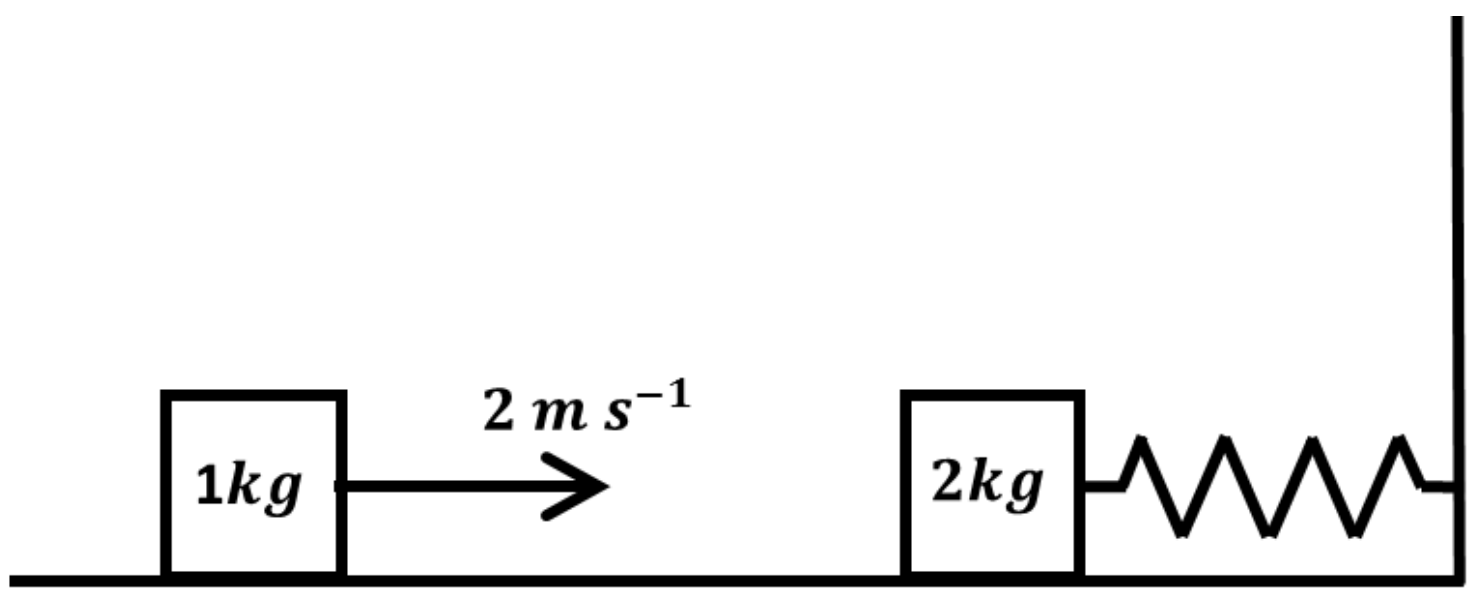
Topics & Concepts
Step-by-Step Solution
To find the separation distance between the two blocks when the spring returns to its unstretched position for the first time after the collision, we proceed in two parts: analyzing the collision and then the subsequent motion of each block.
Step 1: Velocities immediately after the elastic collision
Let:
- (mass of the moving block),
- (mass of the block attached to the spring),
- (initial velocity of , taken along the -direction),
- (initial velocity of ).
Since the collision is perfectly elastic (), the velocity of the first block and of the second block immediately after the collision are given by:
Substituting the given values:
Thus, the block rebounds and moves to the left (-direction) with a constant speed of , while the block moves to the right with an initial speed of .
Step 2: Motion of the block attached to the spring
The block performs simple harmonic motion (SHM) on the frictionless floor with the mean position at the unstretched position of the spring.
The angular frequency of oscillation is:
The time period of one complete oscillation is:
Starting from the mean position at , the block moves to its extreme compressed position and then returns to the mean position (unstretched position of the spring) for the first time after a half-cycle:
At this instant, the block has returned to its initial position where the collision occurred (mean position, ).
Step 3: Separation distance between the blocks
During this time interval , the block moves uniformly to the left with speed .
The distance traveled by the block is:
Since the block is at the initial point of collision, the separation distance between the two blocks is: