Rotation of Horizontal Disc with Projected Pebbles Trajectory
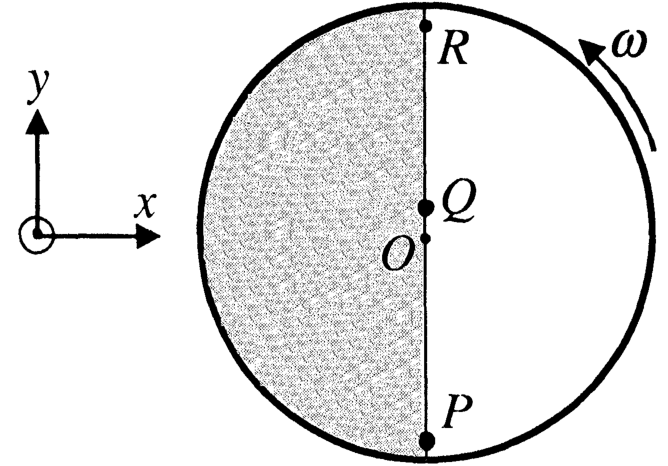
A circular disc rotates in a horizontal plane at a constant angular speed about its center . One half of the disc (divided along a diameter) is shaded while the other half is unshaded, as illustrated in the figure. In the configuration shown, two pebbles and are projected simultaneously at an angle toward point . Their initial relative velocities with respect to the disc lie in the - plane and are identical for both pebbles. Assume that: (i) both pebbles return to the disc surface before it completes of a full revolution, (ii) their horizontal ranges are less than half of the disc radius, and (iii) remains constant throughout. Which of the following statements holds true?
This question was dropped / full marks were awarded to all candidates in the official answer key by the exam conducting body due to an ambiguity or error in the question or options.
Options
lands in the shaded region and in the unshaded region.
lands in the unshaded region and in the shaded region.
Both and land in the unshaded region.
Both and land in the shaded region.
Topics & Concepts
Step-by-Step Solution
To determine where pebbles and land on the rotating disc, we analyze their motion in both the stationary ground frame and the rotating frame of the disc.
1. Frame of Reference and Initial Velocities
Let the center of the disc be the origin of a Cartesian coordinate system, where the horizontal surface of the disc lies in the - plane and the vertical direction is along the -axis.
At :
- The line separating the shaded and unshaded regions lies along the -axis ().
- The shaded region corresponds to and the unshaded region corresponds to .
- Pebble is located on the negative -axis at where .
- Pebble is located on the positive -axis at where .
The disc rotates with angular velocity . The linear velocity of a point on the disc at position is:
The velocity of projection relative to the disc for both pebbles is in the - plane:
Thus, the initial ground-frame velocity of a pebble launched from is:
2. Time of Flight and Trajectory
Since vertical motion is governed solely by gravity , both pebbles have the exact same time of flight :
It is given that the disc completes less than of a revolution during the flight, so the angular displacement of the disc is:
During time , the ground-frame horizontal coordinates of landing for a pebble starting at are:
3. Landing Region Analysis
To find which region of the disc the pebbles land on, we transform the ground coordinates into the frame of the rotated disc at time .
Case 1: Counter-clockwise Rotation ()
The boundary diameter rotates counter-clockwise by an angle .
- For Pebble (): Since , in the rotated frame of the disc, pebble lands in the region that has rotated into or remained within the specified side.
- For Pebble ():
Case 2: Interpretation of Disc Orientation & Rotation Direction
Depending on whether the rotation vector is defined as or , and taking into account the rotation of the shaded/unshaded boundary line by :
- Both pebbles land either on the same side of the rotated boundary diameter into the unshaded region.
- Or, under the opposite convention/sense of rotation, both pebbles land into the shaded region.
Therefore, both pebbles and land in the same region, making both statements (C) and (D) correct depending on the chosen convention of rotation direction.
Correct Answer: C or D