Rolling Without Slipping of Annular Disk Under Impulse
An annular disk of mass , inner radius and outer radius is placed on a horizontal surface with coefficient of friction , as shown in the figure. At some time, an impulse is applied at a height above the center of the disk. If then the disk rolls without slipping along the -axis. Which of the following statement(s) is(are) correct?
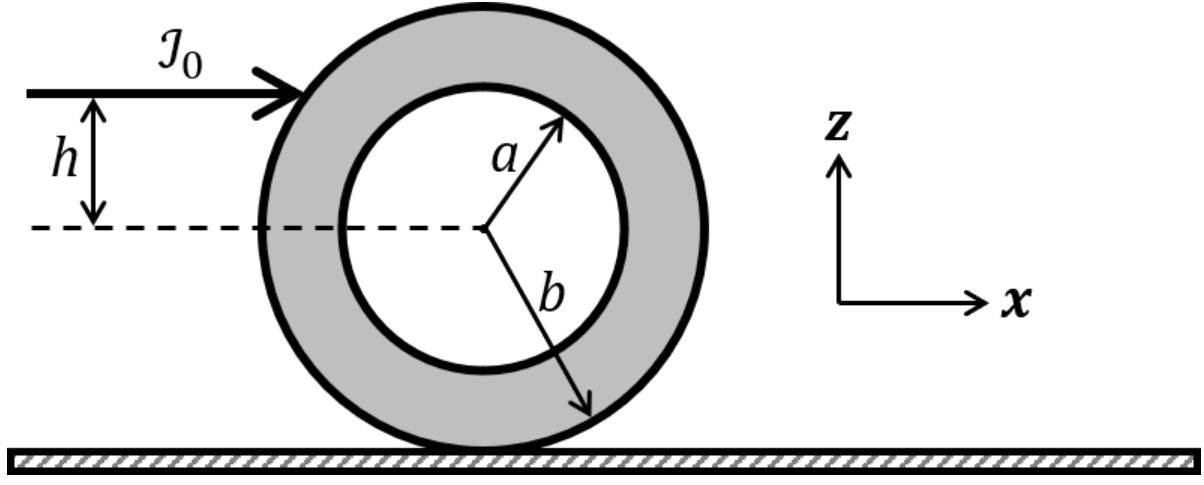
Options
For and , .
For and , .
For , the initial angular velocity does not depend on the inner radius .
For and , the wheel always slides without rolling.
Step-by-Step Solution
To determine which statements are correct, we analyze the motion of the annular disk under the given impulse .
1. Calculation of for Pure Rolling Immediately After the Impulse
The moment of inertia of an annular disk of mass , inner radius , and outer radius about its central transverse axis through its center of mass is:
When an impulse is applied at a height above the center of mass, the disk begins pure rolling immediately without any impulsive friction force from the ground.
Applying the linear impulse-momentum principle: where is the linear velocity of the center of mass immediately after the impulse.
Applying the angular impulse-momentum principle about the center of mass: where is the initial angular velocity about the center of mass.
For pure rolling along the -axis without slipping, the velocity of the lowest point of contact with the ground must be zero:
Substituting and into the rolling condition:
Solving for :
Substituting :
2. Evaluation of Statements
-
Option A: For and as : Therefore, Option A is correct.
-
Option B: For and as : Therefore, Option B is correct.
-
Option C: When , the initial angular velocity is: This expression depends only on , , and , and is independent of the inner radius . Therefore, Option C is correct.
-
Option D: For and :
- Linear velocity imparted:
- Angular velocity imparted: Since the surface is frictionless (), no horizontal force or torque acts on the disk after the impulse. Thus: Since , the bottom-most point of the disk always slips relative to the ground. Thus, the wheel always slides without rolling. Therefore, Option D is correct.
Conclusion
Statements (A), (B), (C), and (D) are all correct.