Deflection of Monochromatic Light Wave Through Gradient Slab
A monochromatic light wave is incident normally on a glass slab of thickness , as shown in the figure. The refractive index of the slab increases linearly from to over the height . Which of the following statement(s) is(are) true about the light wave emerging out of the slab?
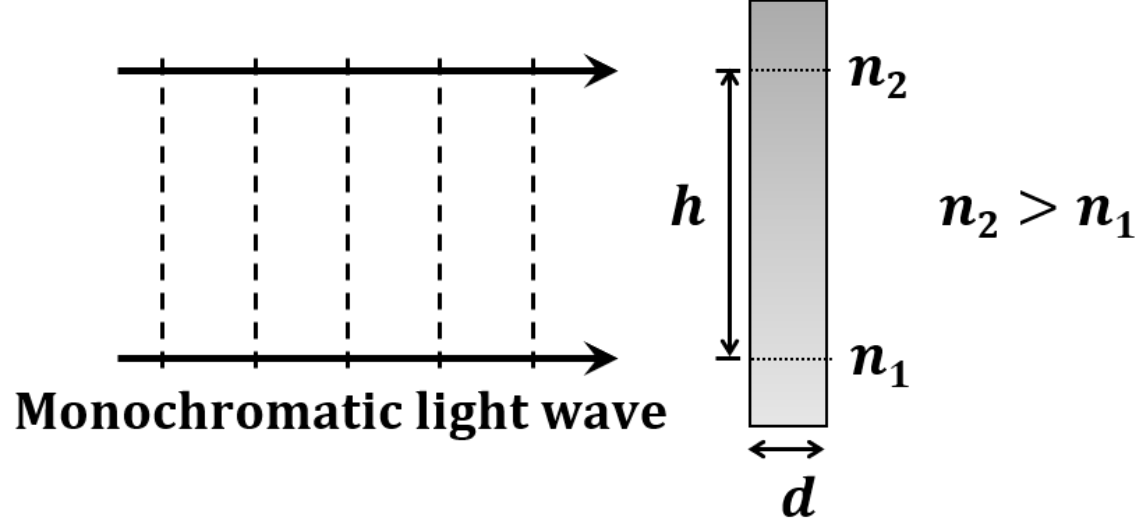
Options
It will deflect up by an angle .
It will deflect up by an angle .
It will not deflect.
The deflection angle depends only on and not on the individual values of and .
Topics & Concepts
Step-by-Step Solution
To determine the deflection of the monochromatic light wave emerging from the glass slab, we analyze the optical path length and wavefront orientation as the wave traverses the medium.
1. Refractive Index Profile
Let be the vertical coordinate measured from the bottom of the slab () to the top (). The refractive index increases linearly from to :
2. Optical Path Length (OPL)
A plane wave is incident normally on the left face of the slab. The optical path length traversed by the light wave at height through the slab of thickness is given by:
3. Wavefront Orientation and Deflection Angle
The phase of the wave emerging at the right face of the slab is:
Since , light at the top of the slab () travels through a region of higher refractive index, meaning its phase velocity is slower compared to the light at the bottom (). Consequently, the wave at the top experiences a larger phase delay, causing the emerging wavefront to tilt backward at the top.
The direction of wave propagation (the ray direction) is always perpendicular to the wavefront. The tangent of the deflection angle relative to the horizontal (-axis) is given by the gradient of the optical path length along the -direction:
Since , the wave vector tilts upward. Therefore, the deflection angle is:
4. Conclusion and Option Analysis
- Option A: Incorrect.
- Option B: Correct. The light wave deflects up by an angle .
- Option C: Incorrect.
- Option D: Correct. The angle depends only on the difference and the geometric parameters and , and not on the individual values of and .
Correct Answer: (B) and (D)