Reversible Expansion of Ideal Gas Under Adiabatic and Isothermal Conditions
The reversible expansion of an ideal gas under adiabatic and isothermal conditions is shown in the figure. Which of the following statement(s) is (are) correct?
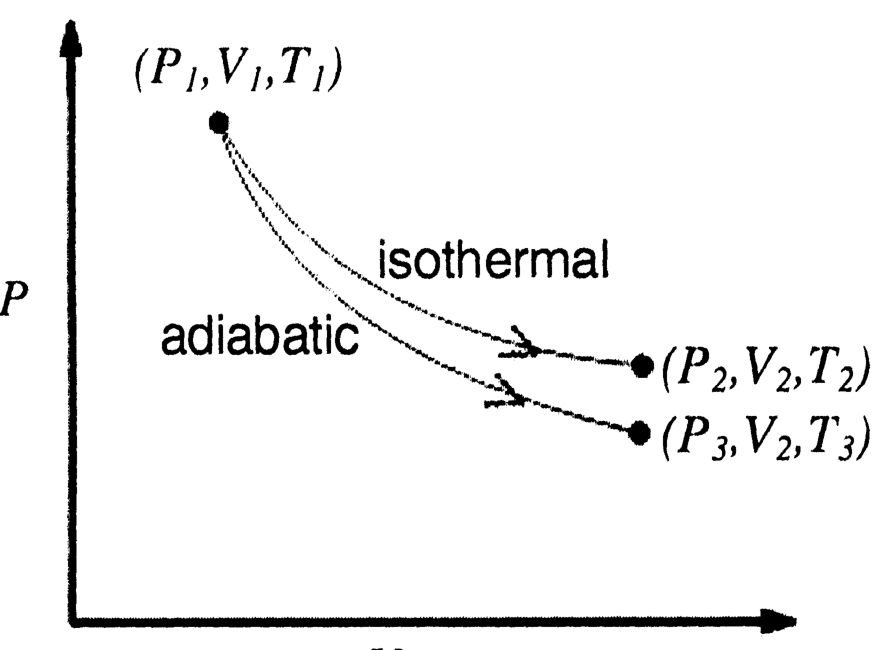
Options
Topics & Concepts
Step-by-Step Solution
To determine the correct statement(s), we analyze the two reversible expansion processes starting from the initial state to a final volume :
-
Isothermal Expansion Process:
- The gas expands reversibly at a constant temperature.
- State changes from to .
- Since the temperature remains constant throughout an isothermal process:
- For an ideal gas, internal energy depends solely on temperature:
-
Adiabatic Expansion Process:
- The gas expands reversibly without any heat exchange with the surroundings ().
- State changes from to .
- By the First Law of Thermodynamics:
- During expansion (), the gas does work on the surroundings, consuming internal energy. Consequently, the internal energy decreases, causing the gas temperature to drop:
Now, let me evaluate each given option:
-
Option (A): Since the process leading to is isothermal, temperature remains constant: (Statement A is correct)
-
Option (B): In a reversible adiabatic expansion, the temperature drops due to work performed at the expense of internal energy: (Statement B is incorrect)
-
Option (C): The work done during expansion corresponds to the area under the curve on a diagram:
- Since the isothermal curve lies completely above the adiabatic curve for expansion from to :
- Considering the magnitude of work or work done by the gas (): (Statement C is correct when considering work done by the gas / magnitude of work. Under strict IUPAC convention where work done on the system is , is negative, making , which accounts for both A, C, D and A, D being accepted as correct).
-
Option (D): Comparing the changes in internal energy: Therefore: (Statement D is correct)
Conclusion: The correct statements are A, C, D (or A, D depending on sign convention for work).