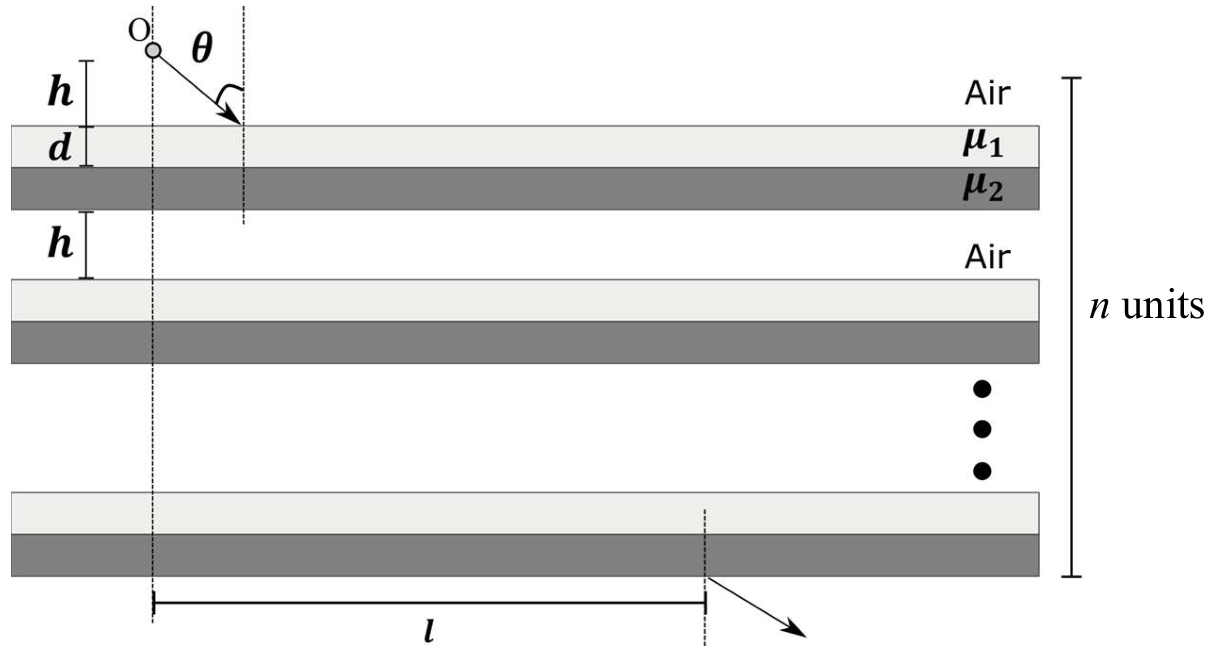
Refraction of Light through Multi-Layered Medium Configuration
Consider a configuration of n identical units, each consisting of three layers. The first layer is a column of air of height h=31 cm, and the second and third layers are of equal thickness d=23−1 cm, and refractive indices μ1=23 and μ2=3, respectively. A light source O is placed on the top of the first unit, as shown in the figure. A ray of light from O is incident on the second layer of the first unit at an angle of θ=60∘ to the normal. For a specific value of n, the ray of light emerges from the bottom of the configuration at a distance l=38 cm, as shown in the figure. The value of n is ______.
To find the number of identical units n, we calculate the horizontal displacement (lateral shift) of the light ray as it passes through each layer of one unit.
1. Refraction in the Air Layer:
The air layer (layer 0) has a height h=31 cm and refractive index μ0=1.
The angle of incidence is θ0=60∘.
The horizontal displacement in this layer is given by:
Δxair=htanθ0=31tan60∘=31×3=31 cm
2. Refraction in the Second Layer (μ1):
The second layer has a thickness d=23−1 cm and refractive index μ1=23.
Applying Snell's Law at the interface between air and the second layer:
μ0sinθ0=μ1sinθ11⋅sin60∘=23sinθ123=23sinθ1⟹sinθ1=21
Thus, the angle of refraction is θ1=45∘.
The horizontal displacement in this layer is:
Δx1=dtanθ1=(23−1)tan45∘=23−1 cm
3. Refraction in the Third Layer (μ2):
The third layer has a thickness d=23−1 cm and refractive index μ2=3.
Applying Snell's Law:
μ0sinθ0=μ2sinθ21⋅sin60∘=3sinθ223=3sinθ2⟹sinθ2=21
Thus, the angle of refraction is θ2=30∘.
The horizontal displacement in this layer is:
Δx2=dtanθ2=(23−1)tan30∘=233−1 cm
4. Total Horizontal Displacement Per Unit:
The total horizontal shift per unit Δxunit is the sum of the horizontal shifts in each of its three layers:
Δxunit=Δxair+Δx1+Δx2Δxunit=31+23−1+233−1Δxunit=31+(3−1)(21+231)Δxunit=31+(3−1)(233+1)
Using the identity (3−1)(3+1)=3−1=2:
Δxunit=31+232=31+31=32 cm
5. Total Displacement for n Units:
The total horizontal distance l after emerging from n units is given as l=38 cm:
l=n⋅Δxunit38=n⋅(32)n=28=4