Electric Flux through Conical Surface of Composite Closed Geometry
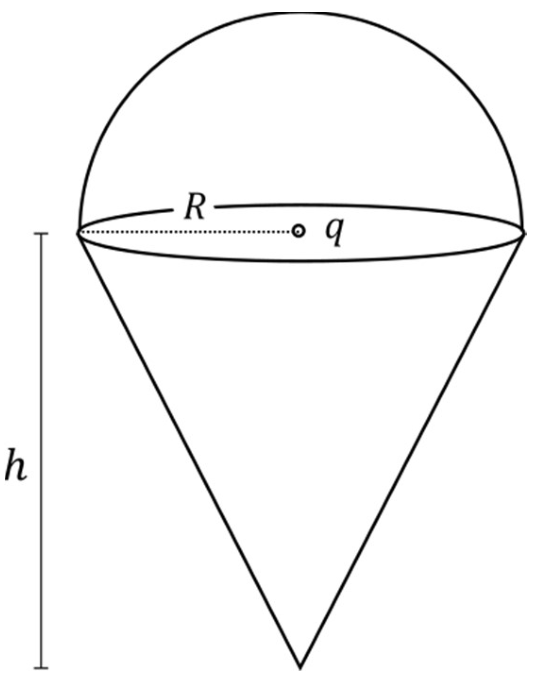
A charge is surrounded by a closed surface consisting of an inverted cone of height and base radius , and a hemisphere of radius as shown in the figure. The electric flux through the conical surface is (in SI units). The value of is ______.
Topics & Concepts
Step-by-Step Solution
To find the electric flux through the conical surface, we analyze the geometry and the solid angle subtended by the conical surface at the position of the point charge .
1. Geometric Analysis
Let the charge be situated at the origin , which is the center of the common circular base of radius separating the upper hemisphere and the lower inverted cone.
- The upper half-space () is bounded by the hemispherical surface of radius .
- The lower half-space () contains the inverted cone of base radius and height , with its vertex located at .
2. Solid Angle Subtended by the Conical Surface
The point charge emits electric field lines isotropically (uniformly in all directions) into a total solid angle of .
Consider any ray emanating from the origin into the lower half-space (). In cylindrical coordinates , a ray extending into the lower region at an angle relative to the negative -axis is given by:
The equation describing the surface of the inverted cone for is:
Equating the ray equation and the surface equation to find the point of intersection:
For every angle , there exists a unique, valid solution for in the range . This proves that every electric field line directed into the lower half-space passes through the conical surface.
Therefore, the conical surface subtends a solid angle corresponding to the entire lower hemisphere:
3. Calculation of Electric Flux
By Gauss's Law, the fraction of the total electric flux passing through the conical surface is equal to the ratio of the solid angle subtended by the conical surface to the total solid angle:
Given that the electric flux through the conical surface is expressed as :
Solving for :