Refraction of Light Ray Through Lens Shaped Media
Two transparent media of refractive indices and have a solid lens shaped transparent material of refractive index between them as shown in figures in Column II. A ray traversing these media is also shown in the figures. In Column I different relationships between and are given. Match them to the ray diagrams shown in Column II.
Column I
(A)
(B)
(C)
(D)
Column II
(p)
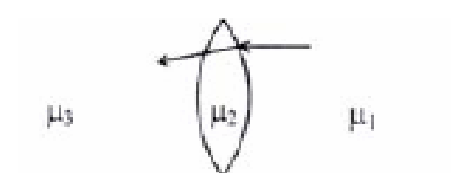
(q)
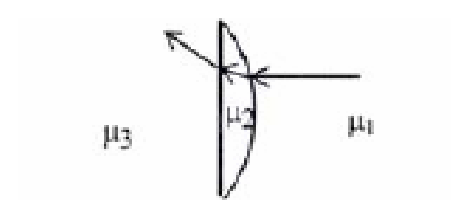
(r)
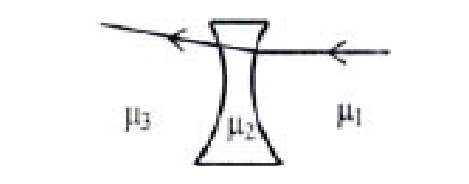
(s)
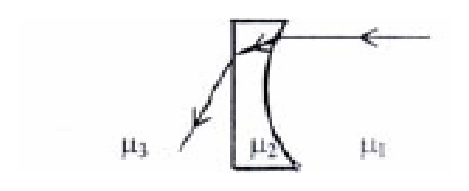
(t)
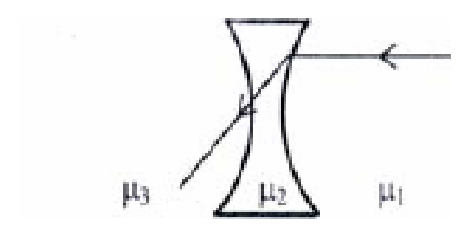
Options
A
B
C
Correct
D
Step-by-Step Solution
To determine the correct matching between Column I and Column II, we analyze the refraction of the light ray at each interface using Snell's Law.
The light ray travels from right to left:
- First interface: from medium with refractive index to the lens of refractive index .
- Second interface: from the lens of refractive index to medium with refractive index .
Recall the fundamental rules of refraction:
- If a ray travels from a rarer medium to a denser medium (), it bends towards the normal.
- If a ray travels from a denser medium to a rarer medium (), it bends away from the normal.
- If there is no deviation at an interface (the ray passes undeviated), the refractive indices of the two adjacent media must be equal ().
Analysis of the Ray Diagrams in Column II:
-
Diagram (p):
- The lens is convex. The incident ray is horizontal in medium and strikes the upper portion of the first curved surface (which is convex towards the right, so its center of curvature lies to the left, inside the lens).
- The normal to this first surface at the point of incidence points downward and to the left.
- The ray bends downwards into the lens, which is towards the normal. Thus, .
- At the second interface (between and ), the ray passes straight through without any deviation. Thus, .
- Therefore, diagram (p) corresponds to:
-
Diagram (q):
- The lens is convex. The incident ray is horizontal in medium .
- At the first interface, the normal points downward and to the left. The ray bends upwards, which is away from the normal. Thus, .
- At the second interface, the ray continues to bend further away from the normal as it emerges into medium . Thus, .
- Therefore, diagram (q) corresponds to:
-
Diagram (r):
- The lens is concave. The first surface has its center of curvature to the right (outside the lens).
- For the upper half, the normal to the first surface points upward and to the left (towards the inside of the lens).
- The ray bends upwards, which is towards the normal. Thus, .
- At the second interface, the ray passes straight without any deviation into medium . Thus, .
- Therefore, diagram (r) corresponds to:
-
Diagram (s):
- The lens is concave.
- At the first interface, the normal points upward and to the left. The ray bends downwards, which is away from the normal. Thus, .
- At the second interface, the ray bends further downward, away from the normal. Thus, .
- Therefore, diagram (s) corresponds to:
-
Diagram (t):
- The lens is concave.
- At the first interface, the ray bends downwards, which is away from the normal. Thus, .
- At the second interface, the ray passes undeviated into medium . Thus, .
- Therefore, diagram (t) corresponds to:
Matching the Columns:
- A) : matches with p, r
- B) : matches with q, s, t
- C) : matches with p, r, t
- D) : matches with q, s