Reaction Sequence and Structural Identification of Unsaturated Hydrocarbon P
Study the chemical reaction sequence starting from compound given below:
Choose the correct option(s).
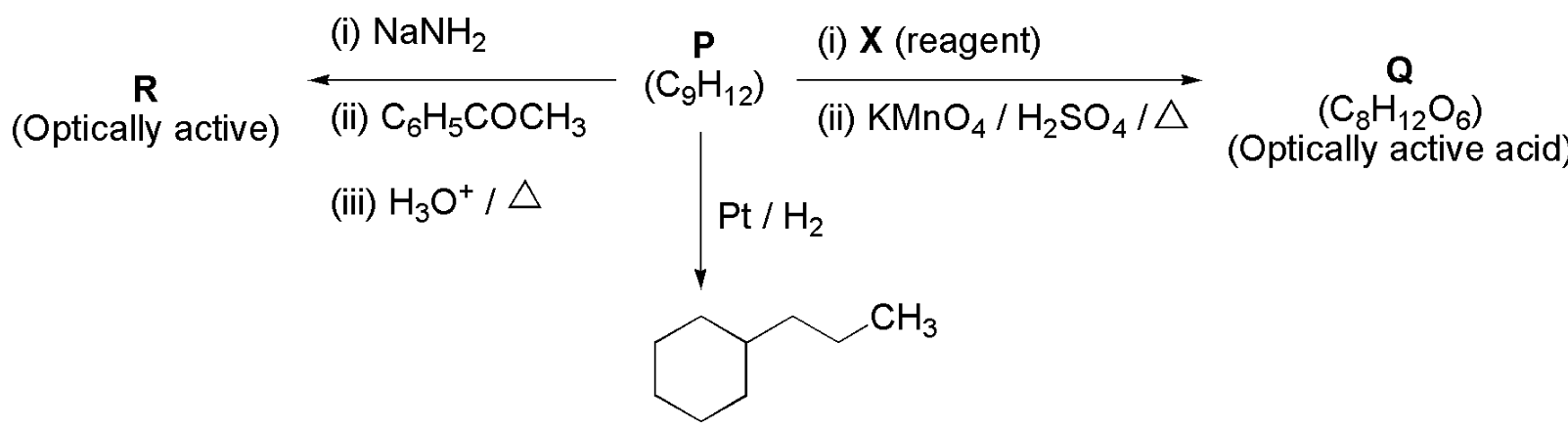
Options
Compound is:
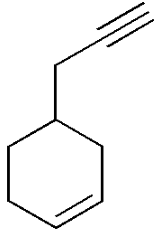
Reagent is .
Compound is:
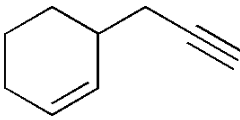
Compound is:
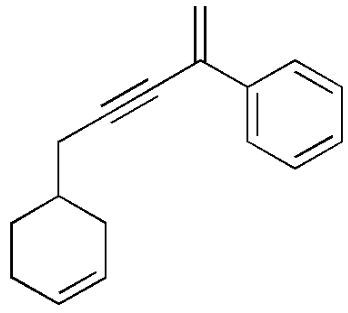
Step-by-Step Solution
To determine the correct option(s), we analyze the step-by-step chemical transformations of compound .
Step 1: Identification of the Carbon Skeleton and Degree of Unsaturation of Compound
-
Catalytic Hydrogenation: Compound () undergoes complete hydrogenation over to yield propylcyclohexane ().
- Molecular formula of propylcyclohexane: (, corresponding to one cyclohexane ring).
- Molecular formula of compound :
- Since hydrogenation yields propylcyclohexane, contains 1 cyclohexane ring and 3 -bonds in total (or 1 double bond + 1 triple bond).
-
Reaction with : reacts with to form an acetylide ion, confirming the presence of a terminal alkyne group ().
Thus, consists of a cyclohexene ring with a propargyl side chain ().
Step 2: Analysis of Reagent and Compound
-
Reagent : The terminal alkyne group in is selectively reduced to an alkene group () without affecting the ring double bond. This selective reduction of an alkyne to a cis-alkene is achieved using Lindlar's catalyst: Hence, Option (B) is correct.
-
Oxidative Cleavage to form (, Optically Active):
- The diene intermediate produced after treatment with is subjected to strong oxidative cleavage using .
- The terminal double bond () is cleaved into a carboxylic acid group () with the loss of one carbon as .
- The double bond in the 6-membered ring is also oxidatively cleaved, opening the ring to generate two additional groups.
- The product is a tricarboxylic acid with 8 carbon atoms ().
Step 3: Determining the Position of the Double Bond in (Option A vs. Option C)
Let's evaluate the two potential positional isomers for :
Case 1: 3-(prop-2-yn-1-yl)cyclohex-1-ene (Allylic substitution - Option A)
- Position of side chain: C3 relative to the ring double bond ().
- After reduction with and oxidative cleavage with :
- Ring double bond between C1 and C2 is cleaved, converting C1 and C2 into groups.
- Side chain is converted to .
- At the C3 carbon, the four attached groups are:
- (from C2)
- (from the side chain)
- (from C4–C5–C6–C1)
Since all four attached groups are distinct, C3 is a chiral center. Therefore, compound is optically active, which matches the given experimental condition.
Case 2: 4-(prop-2-yn-1-yl)cyclohex-1-ene (Homoallylic substitution - Option C)
- Position of side chain: C4 relative to the ring double bond ().
- After oxidative cleavage, the groups attached to the C4 carbon are:
- (from the side chain)
- (from the C3–C2 path)
- (from the C5–C6–C1 path)
Here, two of the attached groups are identical (). Thus, C4 is achiral, making optically inactive, which contradicts the given observation.
Hence, Option (A) is correct and Option (C) is incorrect.
Step 4: Formation and Identification of Compound (Option D)
The sequence of reactions to form is as follows:
- Deprotonation:
- Nucleophilic Addition to Acetophenone:
- Acid-Catalyzed Dehydration (): Elimination of water yields an conjugated enyne derivative:
Since the chiral carbon on the cyclohexene ring remains intact, compound is optically active. This structure corresponds precisely to the structure shown in Option (D).
Hence, Option (D) is correct.
Conclusion
- Option A: Correct ( is 3-(prop-2-yn-1-yl)cyclohex-1-ene)
- Option B: Correct ( is )
- Option C: Incorrect
- Option D: Correct ( is the conjugated enyne product)
Correct Options: A, B, D