Comparison of Basicity and Steric Effects in Substituted Aniline Derivatives
Analyze the structural chemical formulas of the four given organic compounds I, II, III, and IV.
Select the correct statement(s):
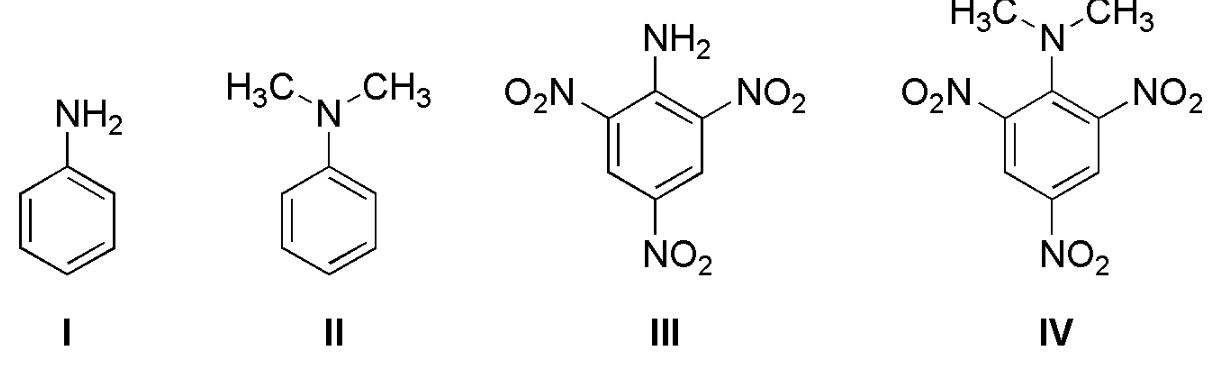
Options
The basicity decreases in the order: .
The difference in values between compounds and is greater than the difference between and .
The resonance stabilization/effect is stronger in compound than in compound .
Steric inhibition of resonance makes compound more basic than compound .
Topics & Concepts
Step-by-Step Solution
To determine the correct statement(s), let us analyze the structural features, electronic effects, and steric hindrance present in the given four organic compounds:
-
Compound I (Aniline, ):
- The nitrogen lone pair is partially delocalized into the benzene ring via resonance (mesomeric effect, ).
-
Compound II (-Dimethylaniline, ):
- The two methyl groups attached to nitrogen exhibit an electron-donating inductive effect (). This increases the electron density on the nitrogen atom relative to aniline, making compound II more basic than compound I ().
- The difference between I and II is small ().
-
Compound III (-Trinitroaniline):
- The group is relatively small in size and remains coplanar with the benzene ring.
- The nitrogen lone pair undergoes extensive delocalization into the aromatic ring and the three strongly electron-withdrawing nitro groups ( and effects at both - and -positions).
- This strong resonance stabilization of the lone pair dramatically reduces the basicity of compound III.
-
Compound IV (-Dimethyl--trinitroaniline):
- The bulky group experiences severe steric repulsion from the two ortho-nitro () groups.
- To minimize this steric crowding, the group twists out of the plane of the benzene ring.
- This non-coplanarity leads to Steric Inhibition of Resonance (SIR). Because the -orbital of nitrogen is no longer parallel to the -system of the benzene ring, delocalization of the nitrogen lone pair into the ring is effectively suppressed.
- As a result, the lone pair on nitrogen remains localized and available for protonation, making compound IV significantly more basic than compound III.
Analysis of the Options:
-
Statement (A): Because of Steric Inhibition of Resonance (SIR) in compound IV, its basicity is restored and is significantly higher than that of compound III. Therefore, the correct order of basicity is: Hence, statement (A) is incorrect.
-
Statement (B): The difference in between I and II is very small ( units). However, the difference in between III and IV is several units (large magnitude) due to the dramatic suppression of resonance in IV caused by the SIR effect. Thus: Hence, statement (B) is incorrect.
-
Statement (C): In compound III, the group remains coplanar with the aromatic ring, allowing full resonance delocalization. In compound IV, the group is twisted out of plane, severely diminishing resonance interaction. Therefore, resonance effect is stronger in compound III than in compound IV. Hence, statement (C) is correct.
-
Statement (D): The steric effect (Steric Inhibition of Resonance, SIR) in compound IV prevents the delocalization of the nitrogen lone pair into the aromatic ring, making the lone pair more available for donation. Thus, steric effect makes compound IV more basic than compound III. Hence, statement (D) is correct.
Conclusion:
The correct statements are (C) and (D).