JEE Challenger
More from Amines

Reaction Sequence Analysis for Toluene Derivatives and Carbylamine Test

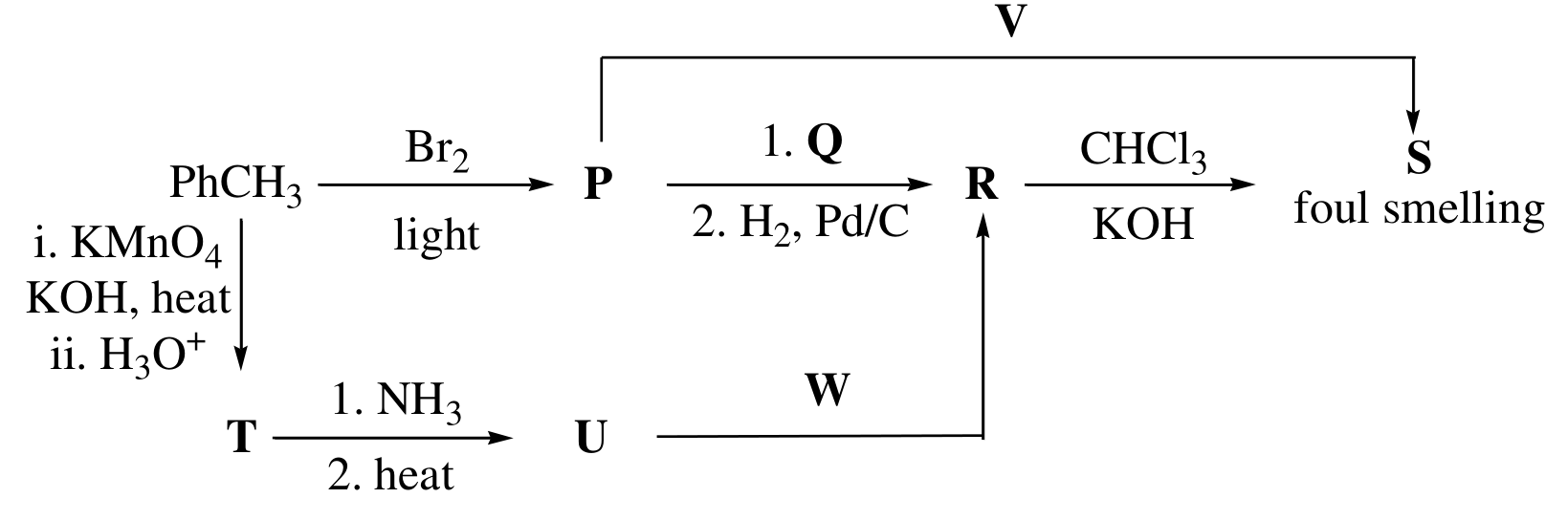
Choose the correct option(s) for the following reaction scheme:

Question Diagram 1

Options

A

Q=KNO2\mathbf{Q} = \text{KNO}_2, W=LiAlH4\mathbf{W} = \text{LiAlH}_4

B

R=benzenamine\mathbf{R} = \text{benzenamine}, V=KCN\mathbf{V} = \text{KCN}

C

Q=AgNO2\mathbf{Q} = \text{AgNO}_2, R=phenylmethanamine\mathbf{R} = \text{phenylmethanamine}

Correct
D

W=LiAlH4\mathbf{W} = \text{LiAlH}_4, V=AgCN\mathbf{V} = \text{AgCN}

Correct

Step-by-Step Solution

To determine the correct options for the given reaction scheme, we analyze each step logically:

  1. Formation of Compound P\mathbf{P}: Reaction of toluene (PhCH3\text{PhCH}_3) with Br2\text{Br}_2 in the presence of light undergoes free radical halogenation: PhCH3+Br2→hνPhCH2Br (P)+HBr\text{PhCH}_3 + \text{Br}_2 \xrightarrow{h\nu} \text{PhCH}_2\text{Br}\ (\mathbf{P}) + \text{HBr} Thus, P\mathbf{P} is benzyl bromide (PhCH2Br\text{PhCH}_2\text{Br}).

  2. Formation of Compounds T\mathbf{T} and U\mathbf{U}:

    • Vigorous oxidation of toluene using alkaline KMnO4\text{KMnO}_4 followed by acidification gives benzoic acid: PhCH3→ii. H3O+i. KMnO4/KOH, heatPhCOOH (T)\text{PhCH}_3 \xrightarrow[\text{ii. }\text{H}_3\text{O}^+]{\text{i. }\text{KMnO}_4/\text{KOH, heat}} \text{PhCOOH}\ (\mathbf{T})
    • Heating benzoic acid (T\mathbf{T}) with ammonia yields benzamide: PhCOOH+NH3→ΔPhCONH2 (U)\text{PhCOOH} + \text{NH}_3 \xrightarrow{\Delta} \text{PhCONH}_2\ (\mathbf{U})
  3. Formation of Compound R\mathbf{R} and Reagent W\mathbf{W}: Benzamide (U\mathbf{U}) is reduced to a primary amine, phenylmethanamine (benzylamine, PhCH2NH2\text{PhCH}_2\text{NH}_2), using lithium aluminium hydride (LiAlH4\text{LiAlH}_4): PhCONH2 (U)→LiAlH4 (W)PhCH2NH2 (R)\text{PhCONH}_2\ (\mathbf{U}) \xrightarrow{\text{LiAlH}_4\ (\mathbf{W})} \text{PhCH}_2\text{NH}_2\ (\mathbf{R}) Thus, W=LiAlH4\mathbf{W} = \text{LiAlH}_4 and R=phenylmethanamine\mathbf{R} = \text{phenylmethanamine}.

  4. Reagent Q\mathbf{Q}: Benzyl bromide (P\mathbf{P}) reacts with silver nitrite (AgNO2\text{AgNO}_2) via nucleophilic substitution through the nitrogen atom (due to the covalent nature of AgNO2\text{AgNO}_2) to form phenylnitromethane, which on catalytic reduction (H2/Pd-C\text{H}_2/\text{Pd-C}) produces phenylmethanamine (R\mathbf{R}): PhCH2Br (P)→AgNO2 (Q)PhCH2NO2→H2/Pd-CPhCH2NH2 (R)\text{PhCH}_2\text{Br}\ (\mathbf{P}) \xrightarrow{\text{AgNO}_2\ (\mathbf{Q})} \text{PhCH}_2\text{NO}_2 \xrightarrow{\text{H}_2/\text{Pd-C}} \text{PhCH}_2\text{NH}_2\ (\mathbf{R}) (Note: KNO2\text{KNO}_2 would primarily form benzyl nitrite, PhCH2ONO\text{PhCH}_2\text{ONO}, making Q=AgNO2\mathbf{Q} = \text{AgNO}_2).

  5. Carbylamine Test to form Compound S\mathbf{S} and Reagent V\mathbf{V}:

    • Treatment of phenylmethanamine (R\mathbf{R}) with chloroform (CHCl3\text{CHCl}_3) and base (KOH\text{KOH}) gives the foul-smelling benzyl isocyanide (S\mathbf{S}): PhCH2NH2 (R)+CHCl3+3KOH→ΔPhCH2NC (S)+3KCl+3H2O\text{PhCH}_2\text{NH}_2\ (\mathbf{R}) + \text{CHCl}_3 + 3\text{KOH} \xrightarrow{\Delta} \text{PhCH}_2\text{NC}\ (\mathbf{S}) + 3\text{KCl} + 3\text{H}_2\text{O}
    • Direct conversion of benzyl bromide (P\mathbf{P}) to benzyl isocyanide (S\mathbf{S}) requires silver cyanide (AgCN\text{AgCN}), as AgCN\text{AgCN} is covalent and nucleophilic attack occurs through nitrogen: PhCH2Br (P)→AgCN (V)PhCH2NC (S)\text{PhCH}_2\text{Br}\ (\mathbf{P}) \xrightarrow{\text{AgCN}\ (\mathbf{V})} \text{PhCH}_2\text{NC}\ (\mathbf{S}) Thus, V=AgCN\mathbf{V} = \text{AgCN}.

Conclusion:

  • Q=AgNO2\mathbf{Q} = \text{AgNO}_2
  • R=phenylmethanamine\mathbf{R} = \text{phenylmethanamine}
  • W=LiAlH4\mathbf{W} = \text{LiAlH}_4
  • V=AgCN\mathbf{V} = \text{AgCN}

Comparing with the given choices:

  • Option (A) is incorrect since Q=AgNO2\mathbf{Q} = \text{AgNO}_2.
  • Option (B) is incorrect since R=phenylmethanamine\mathbf{R} = \text{phenylmethanamine} and V=AgCN\mathbf{V} = \text{AgCN}.
  • Option (C) is correct.
  • Option (D) is correct.

Correct Options: (C) and (D)