Reaction Pathways Leading to Ortho Xylene as Primary Product
Which of the following reaction sequence(s) result in -xylene as the predominant product?
Options
Step-by-Step Solution
To determine which reaction sequence(s) result in -xylene (1,2-dimethylbenzene) as the major product, we analyze each sequence at a high level:
-
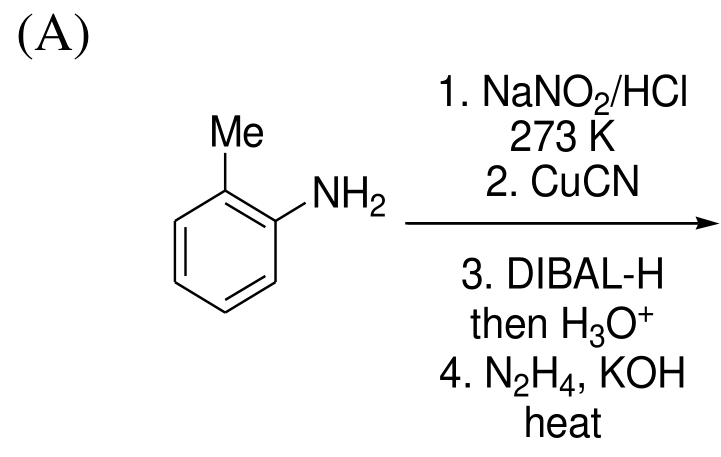
Option (A): Diazotization of -toluidine followed by reaction with yields -tolunitrile. Partial reduction of the nitrile using followed by hydrolysis gives -tolualdehyde. Subsequent Wolff-Kishner reduction () reduces the aldehyde group to a methyl group, yielding -xylene.
-
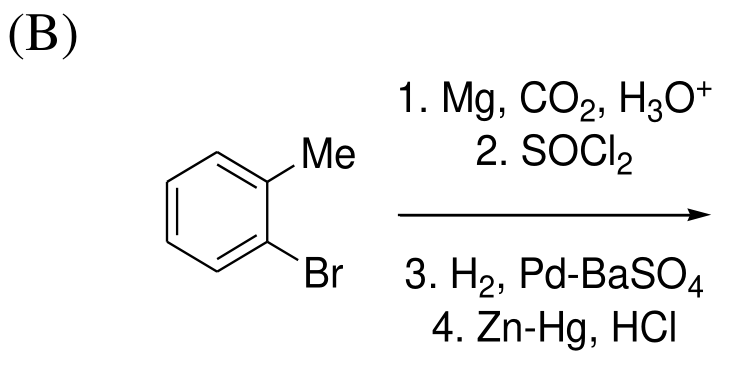
Option (B): Formation of the Grignard reagent from -bromotoluene followed by carboxylation with yields -toluic acid. Conversion to the acyl chloride using followed by Rosenmund reduction () yields -tolualdehyde. Finally, Clemmensen reduction () converts the formyl group to a methyl group, yielding -xylene.
-
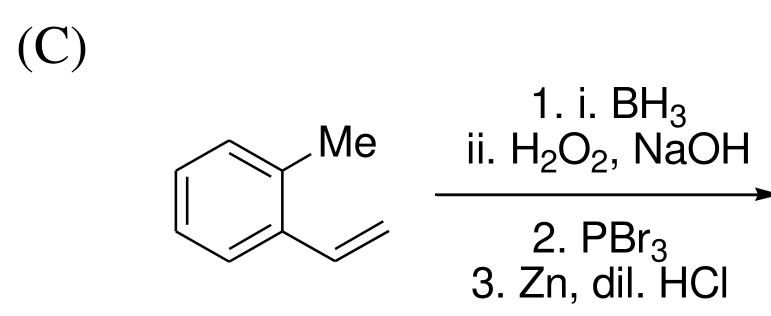
Option (C): Hydroboration-oxidation of -methylstyrene yields . Conversion to the alkyl bromide using followed by reduction with converts the side chain into an ethyl group, resulting in -ethyltoluene instead of -xylene.
-
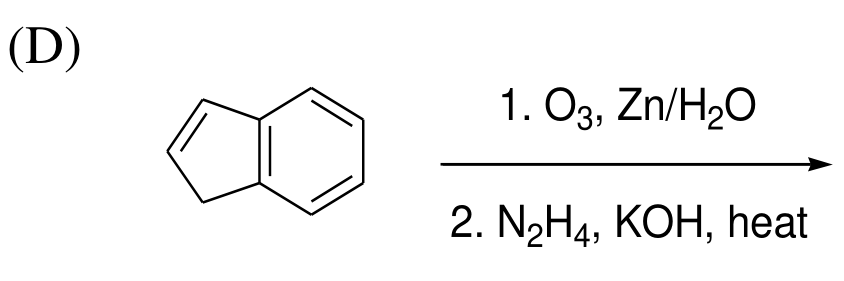
Option (D): Reductive ozonolysis of the bicyclic alkene cleaves the non-aromatic double bond to form a dialdehyde derivative attached to the ring system, which upon Wolff-Kishner reduction does not yield -xylene.
Therefore, only reaction sequences (A) and (B) lead to -xylene as the major product.
Correct Options: (A), (B)